Best Indices Trading Broker in Pakistan

Choosing an indices trading broker in Pakistan requires careful comparison of index access, platform quality, execution, costs, leverage, risk controls, regulation, and mobile account management.
The best indices trading broker in Pakistan should give traders clear access to the stock-market indices they actually want to follow, a capable trading platform, understandable costs, reliable order controls, sensible account management, and transparent information about leverage and risk. A large product list or attractive mobile app is not enough. Traders need to understand what index-linked instrument they are trading, how its price is formed, what costs apply, and what happens when volatility rises.
Medatiq Markets is one option Pakistani traders can evaluate for international index exposure. Its current indices trading service lists major US market benchmarks including US30, US500, and USTEC, with trading access through the MetaTrader 5 platform. Medatiq Markets also provides account-management applications for Android and iOS. Suitability still depends on the instrument structure, current costs, account eligibility, execution conditions, risk limits, and the legal or regulatory requirements that apply to a Pakistan-based user.
How to Choose the Best Indices Trading Broker in Pakistan
A useful broker comparison begins with the markets available rather than the marketing language around them. A trader interested primarily in US equity indices may care most about US30, US500, and technology-heavy index exposure. Another trader may want European, Asian, or other global benchmarks. The first question should therefore be whether the broker provides the specific index instruments required by the trading plan.
The next consideration is the trading environment. Index prices can move rapidly during market openings, economic releases, central-bank announcements, major earnings events, and changes in investor sentiment. A broker should provide an interface where position size, entry price, stop level, target, margin, and open risk can be understood before the order is submitted.
Traders should also confirm exactly what product sits behind the symbol shown on the platform. Index exposure can be provided through different derivative structures depending on the broker and jurisdiction. Trading an index-linked instrument is not the same as purchasing every share inside that index, and it does not necessarily give the trader ownership rights in the underlying companies.
Medatiq Markets Index Trading Access on MetaTrader 5
Medatiq Markets currently presents US30, US500, and USTEC among the major indices available through its index-trading service. These markets represent different parts of the US equity market and can behave differently even during the same trading session.
MT5 provides the market-facing environment for charting, technical analysis, order entry, and position management. The Medatiq Markets customer app serves a different purpose, providing account information, transaction history, real and demo account visibility, and account-management functions.
This combination can be practical for traders who want to use a dedicated trading terminal while keeping account access available on a phone. Desktop users may prefer larger charts for detailed analysis, while mobile access can be useful for account monitoring or checking open positions away from the main workstation.
A trader should still test the workflow before risking meaningful capital. Knowing how to enter, modify, and close an index position is just as important as identifying a possible market opportunity.
US30, US500 and USTEC: Understanding the Main Index Markets
The major US indices do not represent exactly the same companies or weighting methods, so they should not be treated as interchangeable symbols.
US30 Trading and Dow Jones Market Exposure
US30 generally tracks price movements associated with the Dow Jones Industrial Average. The benchmark represents a relatively small group of major US companies and uses a price-weighted methodology, which means higher-priced constituent shares can have a greater effect on index movement.
A trader should therefore avoid assuming that every broad shift in US equities affects US30 in exactly the same way as another index. Sector exposure, constituent performance, interest-rate expectations, and major corporate developments can all influence short-term movement.
The wider US indices analysis framework becomes useful when comparing these differences because it examines US30 alongside other major American benchmarks rather than treating the entire equity market as one instrument.
US500 Trading and S&P 500 Market Drivers
US500 is generally associated with the S&P 500, which contains a much larger group of major US companies and is widely used as a benchmark for the US equity market.
Its movement can reflect corporate earnings, interest-rate expectations, inflation data, employment conditions, economic growth expectations, investor positioning, and changes in risk appetite. Large companies with substantial market capitalizations can have a greater influence on the index than smaller constituents.
Understanding what moves the S&P 500 is therefore more useful than simply reacting to each candle on the trading platform. A technically attractive setup can fail quickly when an unexpected macroeconomic release materially changes the market's expectations.
USTEC Trading and Nasdaq 100 Volatility
USTEC generally reflects technology-heavy Nasdaq 100 exposure. Because large technology and growth-oriented companies account for a significant portion of the benchmark, movements in yields, interest-rate expectations, semiconductor stocks, artificial-intelligence-related companies, and large technology earnings can have a substantial impact.
Growth stocks can be particularly sensitive to changing expectations for interest rates because valuations often depend heavily on future earnings. Sharp changes in bond yields can therefore create noticeable movement in technology-focused indices.
Traders following this market should understand what moves the Nasdaq 100 before assuming that a strong technology trend will continue indefinitely.
Index Trading Costs: Spreads, Commissions and Overnight Charges
Trading costs can determine whether a strategy remains viable after a large number of positions. Traders should compare the actual cost structure attached to the specific index instrument rather than relying on general statements about a broker being inexpensive.
The spread is the difference between the buy and sell prices. Some accounts or instruments may also involve commissions. Positions held beyond the trading day may have financing or swap-related conditions depending on the product and account structure.
These costs affect strategies differently. A trader who holds an index position for several days may care more about overnight financing than someone closing every position during the same session. An active intraday trader may be more sensitive to spreads and execution because the cost is incurred repeatedly.
Current costs can change, so traders should review live account specifications rather than assuming a condition seen previously will remain unchanged.
Index Broker Execution Quality During Volatile Markets
Execution becomes particularly important when indices move quickly. US equity benchmarks can accelerate around inflation data, employment reports, Federal Reserve decisions, market openings, or major corporate earnings.
A trader may request an order at one price but receive execution at another if the market changes before the order is filled. This difference is commonly called slippage. It can work either for or against the trader, although adverse slippage is particularly noticeable when markets are moving rapidly.
Good execution should therefore be evaluated together with liquidity, spread behavior, order type, and the strategy being used. A broker interface that looks fast does not guarantee that every requested price will always be available.
Traders who use several asset classes may also benefit from understanding intermarket analysis, because index movement can be connected with bond yields, currencies, commodities, and shifts in overall risk sentiment.
Leverage and Margin in Index Trading
Leverage allows a trader to control market exposure larger than the cash set aside as margin. This can make index trading capital-efficient, but it also makes risk easier to underestimate.
Suppose a trader deposits $2,000 and opens index exposure equivalent to $20,000. A 2% adverse movement in that exposure represents approximately $400 before considering trading costs. That is 20% of the original account equity.
If the exposure were increased further, the same market move would produce a larger account-level loss.
This is why the broker offering the highest possible leverage should not automatically be considered the best. Understanding leverage and margin is more important than maximizing them. Position size should be based on an acceptable account-level loss if the trade fails, not on the maximum exposure the platform permits.
Risk Management for US30, US500 and USTEC Trades
Index trading can produce fast gains and equally fast losses, particularly when leverage is involved. A disciplined trader therefore decides how much capital can be lost before deciding how large the position should be.
A simple approach begins with a fixed percentage of account equity. If a hypothetical trader has $5,000 and limits risk to 1% per trade, the maximum planned account loss is:
$5,000 × 1% = $50
The position size then needs to reflect the distance between the entry and the invalidation level. A wider technically justified stop requires a smaller position. A narrower stop may permit a larger position, but only if the stop remains outside normal market noise.
A structured trading risk management process also considers correlated exposure. Opening large positions in US30, US500, and USTEC at the same time can create more concentrated US-equity exposure than the trader realizes because all three may react to the same macroeconomic event.
Global Index Trading Beyond the US Market
US indices receive substantial attention, but they represent only one part of the global equity market. Major benchmarks in Europe and Asia can respond to different economic cycles, interest-rate policies, currencies, political developments, and local corporate sectors.
A trader who expands beyond US benchmarks should understand the market hours and economic environment of each region rather than simply copying a US500 strategy onto another index.
Global stock indices can behave differently because each benchmark has a different constituent structure. A market dominated by banks, exporters, industrial companies, or technology firms will respond differently to changes in rates, currencies, commodity prices, and economic expectations.
A large list of index symbols is therefore only useful when the trader understands what each benchmark actually represents.
Index Trading on Android and iPhone in Pakistan
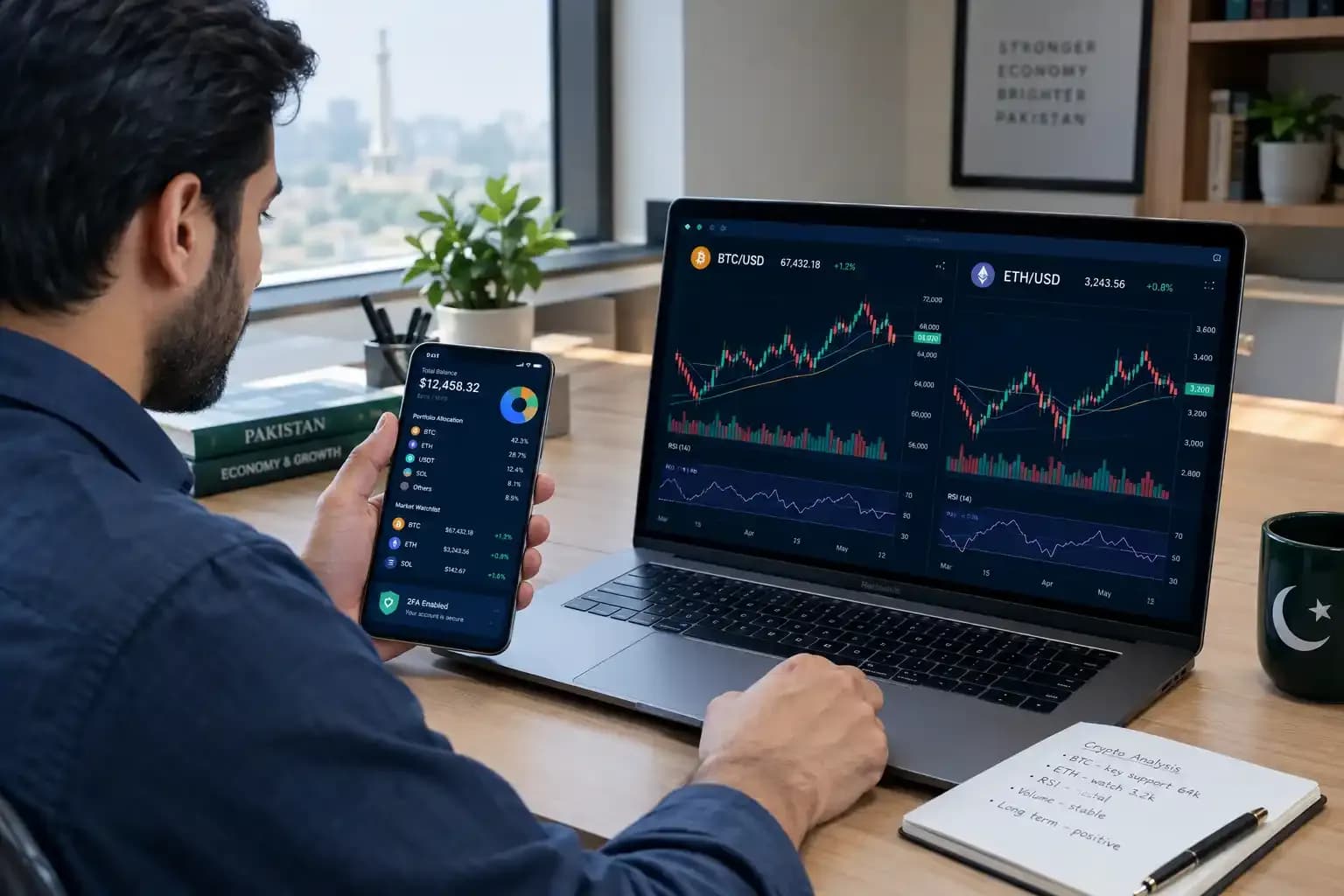
Mobile access can be useful for Pakistani traders because major international index sessions may overlap with working hours, evenings, or other daily commitments in Pakistan Standard Time.
The Medatiq Markets Android and iOS applications provide customer account access, while the MT5 environment can be used for trading and market monitoring on supported devices. This allows traders to keep account information accessible without relying entirely on a desktop computer.
Mobile trading still has practical limitations. Small screens make it harder to analyze multiple timeframes simultaneously, while unstable mobile internet can create problems during fast-moving markets. A trader should not open a leveraged position solely because mobile access makes the process convenient.
Notifications are most useful when they support predetermined price levels or account-management needs. Constant alerts can instead encourage unnecessary entries and overtrading.
Pakistan Regulatory Checks Before Using an Indices Broker
Pakistan-based users should separate two very different ideas: access to an international index price and authorization to provide financial services within Pakistan.
The Securities and Exchange Commission of Pakistan has repeatedly cautioned the public about unauthorized online and offshore trading platforms offering access to securities, forex, commodities, options, and other speculative financial products. A professional-looking website, international company registration, social-media presence, or app-store listing should not be treated as proof that a provider is licensed or authorized in Pakistan.
Users should therefore independently verify the current regulatory position before depositing funds with any index-trading provider. This applies to Medatiq Markets as well as any competing platform. Its availability through MT5 and mobile applications does not by itself establish Pakistani regulatory approval.
Investors seeking conventional securities trading in Pakistan should also understand that direct access to listed securities through the Pakistan Stock Exchange operates within a different regulatory framework from trading international index-linked derivatives through an overseas platform.
How to Compare Index Broker Account Terms Before Funding
The strongest broker comparison examines the complete account process rather than stopping at the trading screen. Traders should understand identity-verification requirements, minimum deposit conditions, supported payment methods, withdrawal procedures, account currencies, margin rules, order sizes, platform access, and customer-support channels.
Withdrawal procedures deserve particular attention. An easy deposit method is only one half of account management. Users should understand how withdrawals are submitted, what verification is required, how long the provider says processing may take, and whether payment-route restrictions apply.
A demo account can also be useful before funding. It allows users to practice chart navigation, order entry, stop placement, position monitoring, and closing procedures without introducing immediate financial risk. Demo performance does not guarantee live results, but operational familiarity can prevent avoidable mistakes.
Why Technical Analysis Alone Is Not Enough for Index Trading
Charts can help identify market structure, momentum, support, resistance, trends, and possible entry locations, but indices are heavily influenced by economic and corporate information.
US500 can react to inflation data, employment reports, earnings, and Federal Reserve expectations. USTEC can move sharply when yields or technology-sector expectations change. US30 may respond differently because of its smaller constituent group and weighting methodology.
A trader can therefore have a technically logical setup that fails because the fundamental market environment changes rapidly.
Combining chart structure with an understanding of index-specific drivers generally provides more context than relying on a single indicator. The objective is not to predict every event, but to understand when the market may be exposed to unusually high uncertainty.
FAQs About the Best Indices Trading Broker in Pakistan
Which indices can Pakistani traders commonly follow?
Major international benchmarks often include US30, US500, USTEC, and various European or Asian indices, depending on the provider. Available instruments and product structures should always be confirmed directly with the broker.
Does Medatiq Markets offer US30, US500 and USTEC?
Medatiq Markets currently lists US30, US500, and USTEC on its indices trading service. Traders should verify current contract specifications, spreads, margin requirements, and availability before opening a position.
Can I trade indices with MetaTrader 5?
MT5 can support index-linked instruments when they are made available by the connected trading provider. The exact symbols and trading conditions depend on that provider.
Is US500 the same as buying S&P 500 shares?
No. An index is a benchmark, not a single company share. A trading provider may offer an index-linked derivative or another form of price exposure rather than ownership of all constituent stocks.
Is USTEC the same as the Nasdaq 100?
USTEC is commonly used by brokers as a symbol associated with Nasdaq 100 price exposure, but symbol naming and contract specifications are provider-specific. Traders should verify the exact instrument before trading.
Is high leverage good for index trading?
High leverage increases potential exposure but also magnifies losses. It should not be treated as evidence that one broker is better than another.
Are spreads important when trading indices?
Yes. Spreads are part of trading costs and can have a significant effect on active strategies. Commissions, financing, and execution differences may also matter depending on the product.
Can I trade US indices from a phone in Pakistan?
Supported mobile platforms can allow market monitoring and trade management, but users should consider screen size, connectivity, execution risk, and account security before relying entirely on a smartphone.
Is an international indices broker automatically authorized in Pakistan?
No. International availability or an app-store listing does not by itself establish Pakistani regulatory authorization. Users should verify current regulatory status and product eligibility independently.
Should beginners use a demo account before trading indices?
A demo account can help beginners learn charting, order placement, position sizing, and platform controls before exposing real capital. Simulated results do not guarantee equivalent live performance.
Conclusion
The best indices trading broker in Pakistan should be judged by market access, platform quality, trading costs, execution, margin rules, risk controls, account management, and current regulatory eligibility. Medatiq Markets provides access to major index markets including US30, US500, and USTEC through MT5, with Android and iOS account access, making it an option to evaluate carefully against those criteria before committing capital.
Disclaimer: Index-linked products can move rapidly, and leverage can magnify losses. Verify current product terms, account eligibility, and applicable Pakistan regulatory requirements before trading; this content is educational and not personalized financial advice.


Trade forex, gold, and indices with Medatiq Markets
Enjoy tight spreads and fast execution, built for market condition.