Forex Trading Basics: A Beginner’s Guide to the Currency Market
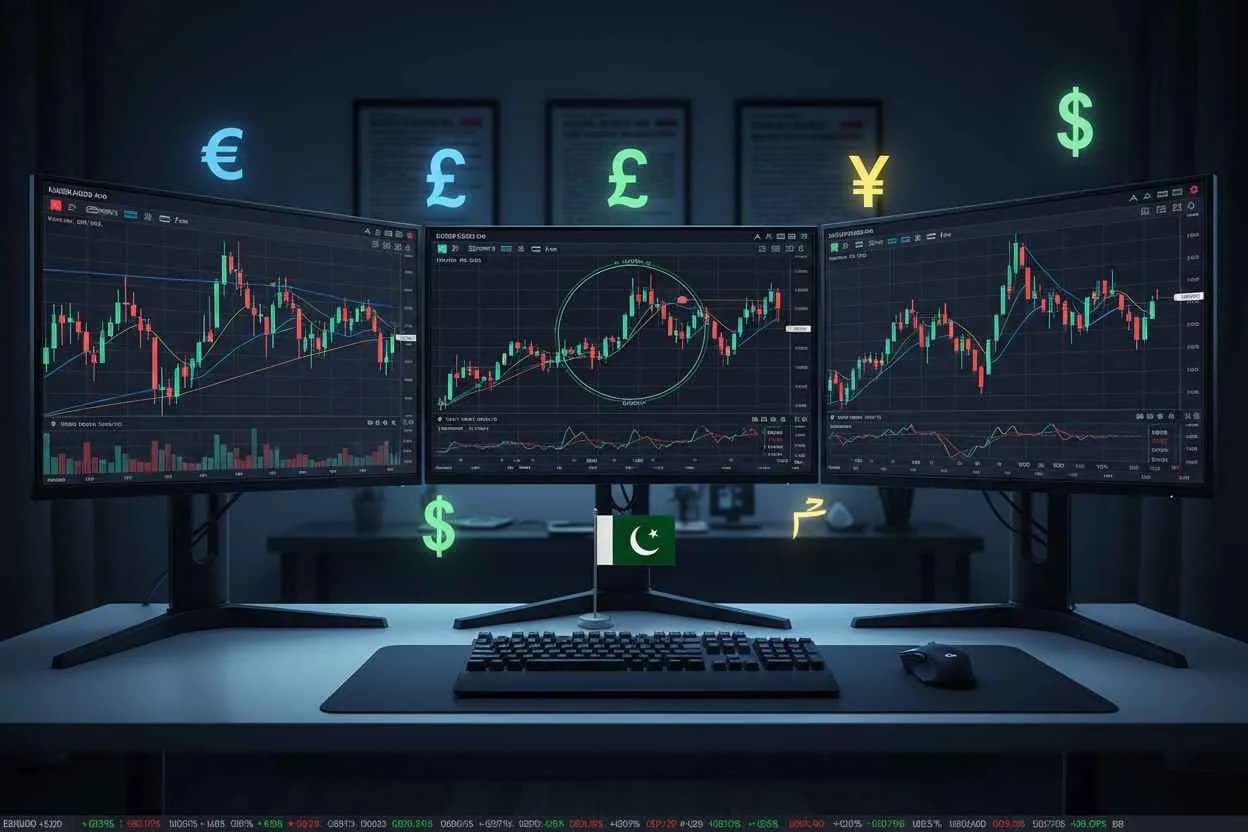
Forex trading involves buying one currency while simultaneously selling another. It takes place in the foreign exchange market, where currencies are traded in pairs such as EUR/USD, GBP/USD and USD/JPY.
Forex trading is the buying and selling of currencies based on changes in their relative value. Unlike a stock, which represents one company, a forex trade always involves two currencies, such as EUR/USD, GBP/USD or USD/JPY. The first currency is compared with the second, and the exchange rate rises or falls as market expectations change. Interest rates, inflation, employment data, central-bank decisions, political events and global risk sentiment can all influence currency prices. Traders can take positions when they expect a pair to rise or fall, but every position carries the possibility of loss. Understanding forex trading basics therefore starts with currency pairs, pips, spreads, position size, leverage and margin rather than trying to predict the next market move. Once these foundations are clear, charts, economic analysis and trading strategies become much easier to understand.
Medatiq provides access to supported currency markets through its forex trading offering, alongside other available markets within its broader trading services.
What Is Forex Trading?
Forex is short for foreign exchange. It refers to the market where one currency is valued against another.
When someone trades EUR/USD, for example, they are trading the relationship between the euro and the US dollar. If EUR/USD rises, the euro has strengthened relative to the dollar during that movement. If it falls, the euro has weakened relative to the dollar.
Suppose EUR/USD is quoted at:
EUR/USD = 1.1000
This means one euro is valued at approximately 1.10 US dollars.
If the price later reaches 1.1050, the euro has gained value relative to the dollar. If it falls to 1.0950, the euro has lost value relative to the dollar.
A trader who expects the pair to rise may take a long position. Someone expecting it to fall may take a short position.
The important point is that forex is always relative. A currency may appear strong in one pair and weaker in another because the other currency in the comparison is also changing.
How Currency Pairs Work
Every forex pair has two parts: a base currency and a quote currency.
In GBP/USD:
Base currency: GBP
Quote currency: USD
If GBP/USD is trading at 1.2800, one British pound is worth approximately 1.28 US dollars.
When the exchange rate rises, the base currency is strengthening relative to the quote currency. When it falls, the base currency is weakening relative to the quote currency.
This is why understanding both economies matters. A move in GBP/USD could result from developments in the United Kingdom, changes in expectations for the United States, or a combination of both.
Major Currency Pairs
Major forex pairs generally combine the US dollar with another heavily traded global currency.
Common examples include EUR/USD, GBP/USD, USD/JPY, USD/CHF, AUD/USD, USD/CAD and NZD/USD.
These pairs usually attract substantial global trading activity, although their liquidity, spreads and volatility still vary throughout the day.
A beginner does not need to follow every major pair at once. Studying a small number of currency pairs makes it easier to understand how economic events and market sessions affect price behavior.
For traders in Pakistan and Khyber Pakhtunkhwa, pairs such as EUR/USD, GBP/USD and USD/JPY are often easier to follow because economic calendars, market commentary and price data are widely available for them.
Cross Currency Pairs
A cross currency pair does not contain the US dollar.
Examples include:
EUR/GBP
EUR/JPY
GBP/JPY
AUD/JPY
Crosses allow traders to compare two currencies directly without using the dollar as one side of the pair.
They can behave differently from major pairs because the economic forces influencing both currencies may be different. GBP/JPY, for example, can react to developments affecting both the British pound and Japanese yen.
Bid and Ask Prices
A forex quote normally shows two prices: the bid and the ask.
Imagine EUR/USD is quoted as:
Bid: 1.1000
Ask: 1.1002
The bid is generally the price available when selling the base currency, while the ask is the price available when buying it.
A trader opening a buy position usually enters around the ask price. A trader opening a sell position usually enters around the bid, subject to actual market conditions and execution.
The gap between the bid and ask is called the spread.
What Is a Forex Spread?
The spread is the difference between the bid price and ask price.
Using the example above:
Ask: 1.1002
Bid: 1.1000
Spread: 0.0002
For EUR/USD, that difference represents two pips.
Spreads are one of the costs that can affect a forex trade. Depending on the account and instrument, other costs may include commissions or overnight financing.
Spreads can also change. During active periods with strong liquidity, they may be relatively narrow. Around major economic announcements or periods of reduced liquidity, they can widen.
This is why the cost of entering the same currency pair can differ at different times of day.
What Is a Pip?
A pip is a standard unit used to describe movement in a forex exchange rate.
For many currency pairs, one pip corresponds to the fourth decimal place.
If EUR/USD moves from:
1.1000 to 1.1001
the movement is one pip.
If it moves from:
1.1000 to 1.1010
the movement is 10 pips.
A move from:
1.1000 to 1.1050
equals 50 pips.
Japanese yen pairs are usually quoted differently. For USD/JPY, a movement from 150.00 to 150.01 represents one pip under the conventional pip definition.
Pips make it easier to describe market movement, but they do not tell you how much money was gained or lost.
That depends on the size of the position.
Position Size and Why It Matters
Position size determines how much market exposure a trader takes.
Two traders can enter EUR/USD at the same price and close after exactly the same 30-pip movement while experiencing very different financial results.
One may have taken a much larger position.
The market moved the same distance for both traders, but their exposure was different.
This leads to one of the most important forex trading basics: market direction and financial risk are separate decisions.
Before opening a position, a trader should understand not only where the currency pair might move but also how much money could be lost if the market moves in the opposite direction.
Going Long in Forex
Going long means taking a position that benefits if the currency pair rises, before accounting for applicable trading costs.
Suppose EUR/USD is trading at:
1.1000
A trader expects the euro to strengthen relative to the dollar and buys EUR/USD.
If the pair later reaches:
1.1060
the market has moved 60 pips in the anticipated direction.
If EUR/USD instead falls to 1.0940, it has moved approximately 60 pips against the position.
Going Short in Forex
A short position works in the opposite direction.
Suppose GBP/USD is trading at 1.2800 and a trader expects the pound to weaken relative to the dollar.
The trader sells GBP/USD.
If the pair falls to 1.2750, the movement favors the short position. If it rises to 1.2850, the movement goes against it.
Being able to buy or sell does not make forex trading easier or safer. A trader can lose money in either direction when the market moves differently from the original expectation.
What Moves Forex Prices?
Currency prices respond to changing expectations across global financial markets.
Interest Rates
Interest-rate expectations can have a major influence on currencies.
Central banks use monetary policy to influence economic conditions. When traders begin expecting rates to rise or fall, currencies may move before the central bank actually changes policy.
For example, expectations surrounding the US Federal Reserve can affect the US dollar, while decisions by the Bank of England can influence the British pound.
Inflation
Inflation is closely watched because it can influence future monetary policy.
If inflation is stronger or weaker than markets expected, traders may reassess the likely path of interest rates. That change in expectations can move currency pairs quickly.
Employment Data
Employment reports can provide information about economic activity and wage pressures.
Strong or weak labor-market data may change expectations for interest rates, economic growth and currency demand.
Economic Growth
Measures of economic growth help traders assess the relative strength of different economies.
A stronger economy does not automatically mean a stronger currency, but economic performance can influence investment flows and central-bank expectations.
Political and Geopolitical Events
Elections, trade disputes, conflicts and major changes in government policy can increase uncertainty and affect currency markets.
The effect depends on which economies and currencies are involved.
Expectations
Forex prices often react to the difference between what the market expected and what actually happened.
A strong economic report may produce little movement if traders had already expected an even stronger result. A weaker-than-expected number can sometimes trigger a much larger reaction.
The headline itself is only part of the story.
Forex Trading Sessions
Forex trading follows activity across major financial centers around the world.
The market is commonly discussed in terms of the Sydney, Tokyo, London and New York sessions.
Because these sessions overlap, currency trading remains active across most of the working week.
Market behavior can still change considerably depending on the time of day.
The London session often brings significant activity in European currency pairs, while the overlap between London and New York can produce heavier participation in pairs such as EUR/USD and GBP/USD.
For someone trading from Peshawar, Mardan, Abbottabad, Swat, Kohat or another city in Khyber Pakhtunkhwa, forex sessions need to be viewed in Pakistan Standard Time (PKT) rather than the local time of London, New York or Tokyo.
Overseas daylight-saving changes can shift the Pakistan-time equivalent of some market sessions during the year, so checking current session times is more reliable than memorizing one fixed schedule.
What Is Leverage in Forex?
Leverage allows a trader to control a market position larger than the capital required as margin.
Suppose a trader has exposure to a $10,000 position.
If that position moves 1%:
$10,000 × 1% = $100
That $100 movement is based on the full market exposure.
This is why leverage can magnify results. It can increase gains when the market moves favorably, but it can also increase losses when the market moves against the position.
Available leverage should not be confused with appropriate risk.
Being allowed to open a larger position does not mean a trader should use the maximum available exposure.
What Is Margin?
Margin is the amount of account equity required to open or maintain a leveraged position under the applicable trading conditions.
Margin is not necessarily a fee.
If a position requires $500 of margin, that does not mean $500 has been charged as a trading cost. Instead, that amount is associated with supporting the larger market exposure.
As open positions gain or lose value, account equity and available margin change.
Large losses can reduce available margin and may eventually lead to positions being closed according to the account's margin rules.
Understanding leverage without understanding margin gives an incomplete picture of trading risk.
How Forex Profit and Loss Work
Consider a simple example.
A trader buys EUR/USD at:
1.1000
The position is later closed at:
1.1050
The market movement is:
1.1050 − 1.1000 = 0.0050
That represents 50 pips.
But we still cannot calculate the trader's monetary profit from this information alone.
We also need the position size and resulting pip value. Trading costs may need to be included as well.
If another trader took a position twice as large, the same 50-pip movement would have a larger monetary effect.
This is why experienced traders pay close attention to exposure rather than evaluating trades only by how many pips a market moved.
Forex Orders
A forex order is an instruction used to enter or manage a trade.
A market order generally seeks to enter at the currently available market price.
Pending orders can be placed to request execution when the price reaches specified conditions.
Stop-loss and take-profit instructions can also be used to manage open positions.
A stop-loss defines a level at which the trader intends to exit if the market moves unfavorably. A take-profit instruction defines a level where the position may be closed if the market moves favorably.
Actual execution can still be affected by market liquidity, volatility and price gaps.
Trading Forex on MetaTrader 5
Medatiq provides supported market access through the MetaTrader 5 platform.
MetaTrader 5 allows traders to view price charts, change chart timeframes, apply technical indicators and manage orders from one interface.
A trader following EUR/USD from Peshawar can view the same underlying market movement as a trader elsewhere in Pakistan or abroad. The location changes the local clock and practical trading routine, but not the underlying international currency market.
Charts and indicators can help organize market information, but they cannot guarantee the next price movement.
Understanding the platform is therefore useful, but platform skill should be combined with market knowledge and disciplined risk management.
Information about the company and its trading environment is available on the Medatiq Markets page.
Technical Analysis in Forex
Technical analysis studies historical price behavior.
Forex traders may use price charts to identify trends, support and resistance areas, momentum or changes in volatility.
Common tools include moving averages, RSI, MACD and candlestick patterns.
A trader might notice that GBP/USD has repeatedly reacted near a particular price area. That observation can become part of the analysis, but it does not guarantee that the same level will hold again.
Technical analysis is a framework for interpreting market behavior, not a method for knowing future prices with certainty.
Fundamental Analysis in Forex
Fundamental analysis focuses on economic and financial conditions.
A forex trader may monitor interest rates, inflation, employment data, economic growth and central-bank policy.
Because every forex pair contains two currencies, both sides matter.
Someone studying EUR/USD may compare economic conditions in the euro area with those in the United States.
Someone following GBP/USD may pay attention to both UK developments and US economic data.
Pakistani traders often encounter important international economic releases during afternoon or evening hours in PKT, depending on the market and season. Keeping an economic calendar aligned with Pakistan time can make it easier to understand why volatility suddenly increases.
A Simple Forex Trade Example
Suppose EUR/USD is trading at 1.1000.
A trader believes the euro may strengthen and buys the pair.
EUR/USD later reaches:
1.1040
The movement is:
1.1040 − 1.1000 = 0.0040
That equals 40 pips.
Now imagine the position had instead fallen to:
1.0960
The market would have moved 40 pips against the trader.
The number of pips is identical, but the monetary result depends on position size.
If trading costs are involved, those must also be considered when calculating the final outcome.
Risk Management for Forex Beginners
Forex risk management begins before the order is placed.
A trader should understand how large the position is, how much account capital could be affected and what would happen if the original market view proves wrong.
Position size is especially important.
A strong analysis can still lead to a damaging loss when the trade is too large relative to the account.
Leverage can make this problem worse because it allows large market exposure with a relatively small margin requirement.
For beginners, protecting capital should receive at least as much attention as finding an entry.
Stop-Loss Orders and Risk
A stop-loss can help define where a trader intends to exit when a position moves unfavorably.
Suppose a trader buys EUR/USD at 1.1000 and decides that the trade idea would no longer make sense below 1.0950.
A stop-loss may be placed near that level according to the trader's plan and the available order structure.
However, a stop-loss does not guarantee the exact exit price in every situation.
Fast-moving markets, gaps and reduced liquidity can affect execution.
A stop-loss is therefore one part of risk management rather than a complete risk-management system by itself.
Common Forex Trading Mistakes
Trading Too Large
Beginners sometimes focus so heavily on price direction that they overlook position size.
A correct market view with excessive exposure can still create poor risk management.
Using Too Much Leverage
High leverage can make relatively small price movements produce significant changes in account equity.
The ability to open a large position should not determine how large the position actually is.
Trading Without a Plan
Entering because the market suddenly moved or because a chart “looks good” can lead to inconsistent decisions.
A trader should understand why the position is being opened and what conditions would invalidate the idea.
Ignoring Trading Costs
A small expected market move can become much less attractive when spreads, commissions or financing costs are considered.
Chasing Economic News
Major economic releases can create sudden volatility.
Entering after a large move has already happened may expose the trader to sharp reversals and unfavorable execution.
Overtrading
More trades do not automatically produce better results.
Repeatedly entering low-quality positions can increase trading costs and emotional pressure.
Depending on One Indicator
No technical indicator works perfectly under every market condition.
Indicators respond to market data and can generate false or late signals.
Learning Forex from Pakistan and KPK
The fundamentals of forex do not change depending on whether a trader is in Lahore, Karachi, Islamabad or Khyber Pakhtunkhwa. What does change is the practical routine around a global market.
A trader in Peshawar may see London-market activity begin during the afternoon in Pakistan, while important US economic releases can occur later in the day. Someone in Abbottabad, Mardan, Swabi, Nowshera, Mansehra or Dera Ismail Khan follows the same international currency prices but plans around PKT.
Internet reliability and having uninterrupted access to the trading platform can also matter when managing open positions, particularly around volatile market events. A trader who cannot monitor a position continuously should take that limitation into account when deciding how much risk to carry.
Local currency is another practical consideration. Even when the trading instrument is EUR/USD or GBP/USD rather than PKR, someone managing personal finances in Pakistani rupees may naturally think about gains and losses in PKR terms. That makes it important to understand the account currency and how changes in exchange rates can affect the real-world value of trading results.
Can Beginners Use a Demo Account?
A demo account can be useful for learning platform mechanics without immediately putting real money at risk.
It allows beginners to practice opening and closing positions, changing chart timeframes and becoming familiar with order types.
However, demo performance should not be treated as proof that the same results will occur with a live account.
Real trading introduces financial pressure, emotional reactions and execution conditions that may not be identical to a simulated environment.
Demo trading is most useful when treated as practice rather than a performance guarantee.
What Should a Forex Beginner Learn First?
Start with how currency pairs are quoted.
Then understand bid and ask prices, spreads and pips.
After that, learn how position size affects pip value and monetary exposure.
Leverage and margin should come next because they determine how much market exposure can be controlled with available account capital.
Once those foundations are clear, order types, forex sessions, economic analysis, technical analysis and trading strategies become easier to understand.
The Medatiq blog provides educational material covering financial markets, trading methods and risk concepts for traders building their market knowledge.
Forex Trading Basics FAQs
What is forex trading in simple terms?
Forex trading involves taking a position on how one currency will move relative to another. Every forex trade uses a pair such as EUR/USD or GBP/USD.
What does EUR/USD mean?
EUR/USD shows the value of the euro relative to the US dollar. If EUR/USD trades at 1.1000, one euro is valued at approximately 1.10 US dollars.
What is a pip?
A pip is a common unit used to describe changes in forex prices. For many currency pairs it corresponds to the fourth decimal place.
What is a forex spread?
The spread is the difference between the bid and ask prices. It represents one component of the cost of entering and exiting a position.
What is leverage?
Leverage allows traders to control market exposure greater than the capital required as margin. It can amplify gains and losses.
What is margin?
Margin is the amount of account equity required to support a leveraged position according to the applicable trading conditions.
Can I trade forex from Pakistan?
Availability depends on the trading provider, account eligibility, products and applicable conditions. Anyone considering forex trading in Pakistan should understand the account terms and risks before committing funds.
Is forex trading different in KPK?
The underlying currency market is the same. A trader in Peshawar, Mardan, Swat or Abbottabad sees the same international forex market, although local time, account access and practical trading conditions affect how the person participates.
Which forex session is best for traders in Pakistan?
There is no single best session. The most suitable period depends on the currency pair, strategy and trader's schedule. London and New York activity is particularly relevant to many major pairs, while Asian currencies may be more active earlier in the day.
Why do forex session times change in Pakistan?
Pakistan Standard Time does not follow the same daylight-saving changes used by some international financial centers. As a result, the PKT equivalent of London or New York market hours can shift during the year.
Which currency pair should a beginner learn first?
There is no universally best pair. Major pairs such as EUR/USD and GBP/USD are commonly studied because market information is widely available, but they can still be volatile and produce losses.
Can forex spreads change?
Yes. Spreads can widen or narrow according to liquidity, volatility, trading activity and market conditions.
Can forex trading cause losses?
Yes. Currency prices can move against a position, and leverage can make losses significantly larger relative to the capital used as margin.
Does a stop-loss guarantee the exact price?
No. Stop-loss orders can help manage risk, but market gaps, volatility and liquidity conditions may affect the actual execution price.
Can MetaTrader 5 predict currency prices?
No. MetaTrader 5 provides charts, indicators and order-management tools. It does not know where a currency pair will move next.
Is technical analysis necessary for forex trading?
Not necessarily. Traders may use technical analysis, fundamental analysis or both. Each method looks at the market from a different perspective.
Is demo trading useful for beginners?
Yes. It can help beginners learn platform functions and practice order placement. Demo results, however, do not guarantee future performance in a live account.
How much money should a beginner risk on forex?
There is no universal amount suitable for everyone. Risk depends on personal financial circumstances, account size, position size, leverage and tolerance for loss.
Can I trade forex at night from Pakistan?
Yes, major international forex markets remain active during many evening hours in Pakistan. The amount of liquidity and volatility depends on which global sessions are open and which currency pair is being traded.
What should I learn after forex trading basics?
Useful next topics include currency pairs, spreads, pip values, position sizing, leverage, margin, trading sessions, order types, technical analysis, fundamental analysis and risk management.
Disclaimer: Forex trading uses leveraged financial products that can produce substantial losses, particularly when positions are large relative to available account capital. This beginner guide is intended to explain how the currency market works and should not be treated as individualized investment, trading, financial, tax or legal advice. Trading conditions, available instruments, spreads, margin requirements and account features offered through Medatiq may change over time.

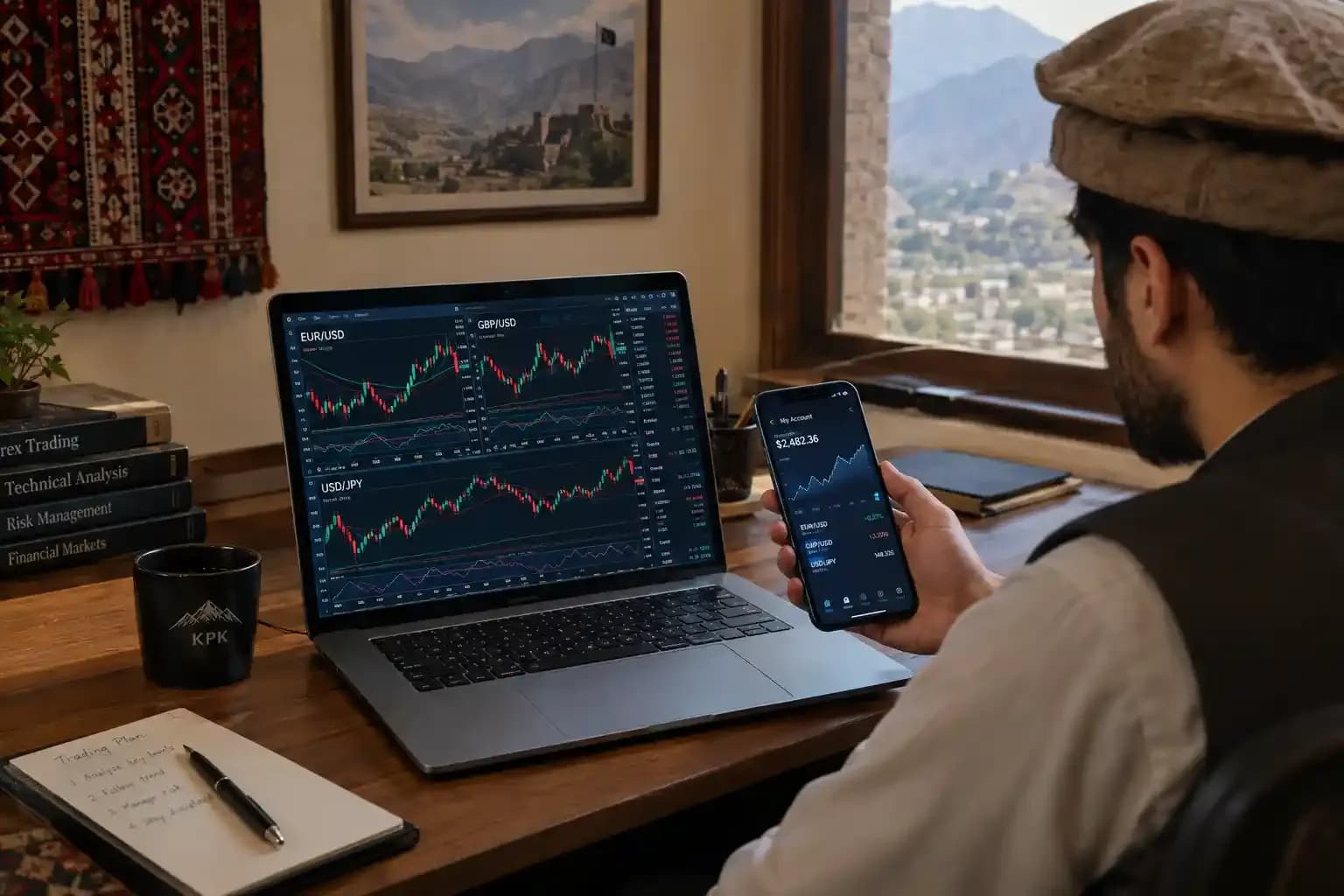
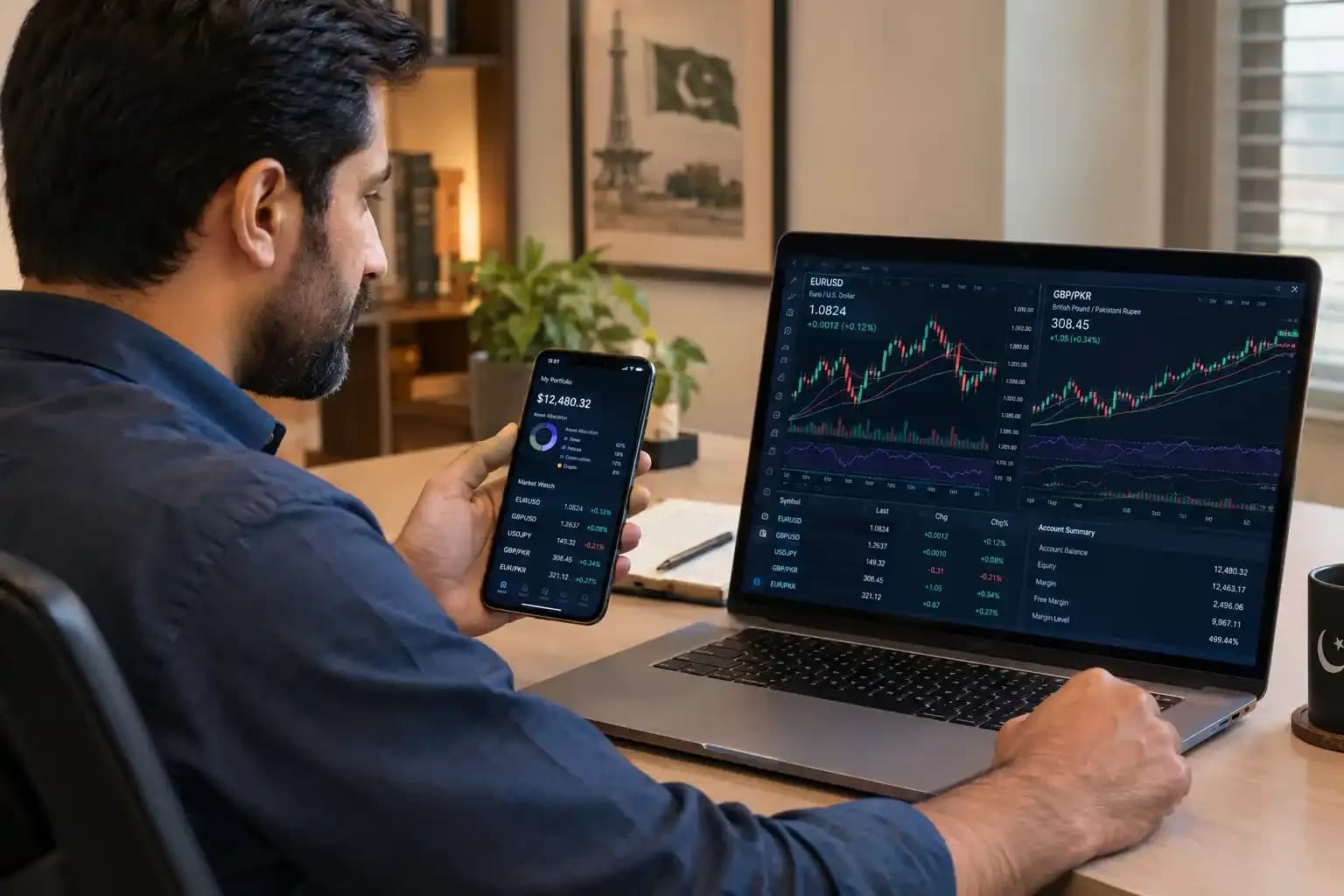
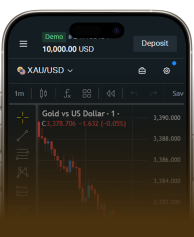
Trade forex, gold, and indices with Medatiq Markets
Enjoy tight spreads and fast execution, built for market condition.