Limit Orders Explained: Buy Limit vs Sell Limit
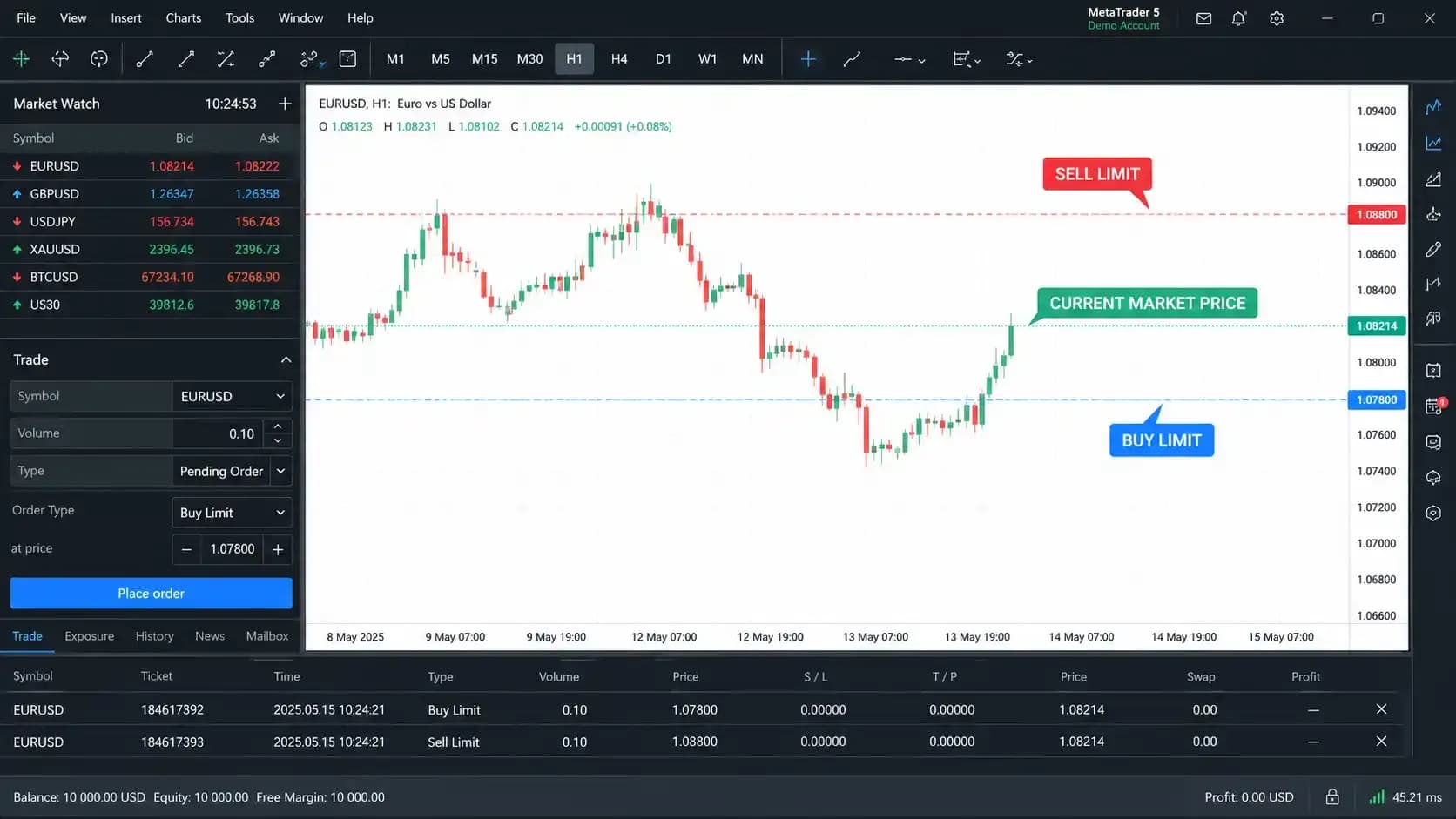
A limit order lets a trader choose a specific price at which they are willing to buy or sell instead of entering immediately at the current market price. A buy limit is normally placed below the current price because the trader wants to buy only after the market falls to a more favorable level. A sell limit is normally placed above the current price because the trader wants to sell only after the market rises to the chosen level. This gives greater control over entry price, but it creates an important trade-off: the market may never reach the limit price, so the trade might not happen. Even when the price reaches the chosen level, execution can depend on liquidity and market conditions. Understanding how a limit order works is therefore essential before using pending orders in forex, gold, indices or cryptocurrency markets.
Limit orders are one of several trading order types available to traders. Medatiq provides access to supported markets through its trading services and the MetaTrader 5 platform.
What Is a Limit Order?
A limit order is an instruction to buy or sell an instrument at a specified price or under price conditions considered at least as favorable as the limit.
Instead of entering immediately, the order waits.
Suppose EUR/USD is trading at:
1.1050
A trader believes the pair may fall toward 1.1000 before recovering.
Rather than buying at 1.1050, the trader places a buy limit at:
1.1000
If the market reaches the required price and the order can be filled, a long position may open.
If EUR/USD rises directly from 1.1050 without first reaching 1.1000, the limit order remains unfilled.
This is the defining characteristic of a limit order: greater control over the requested entry price in exchange for less certainty that a position will be opened.
Buy Limit vs Sell Limit
The difference between a buy limit and sell limit depends on where the trader wants to enter relative to the current market.
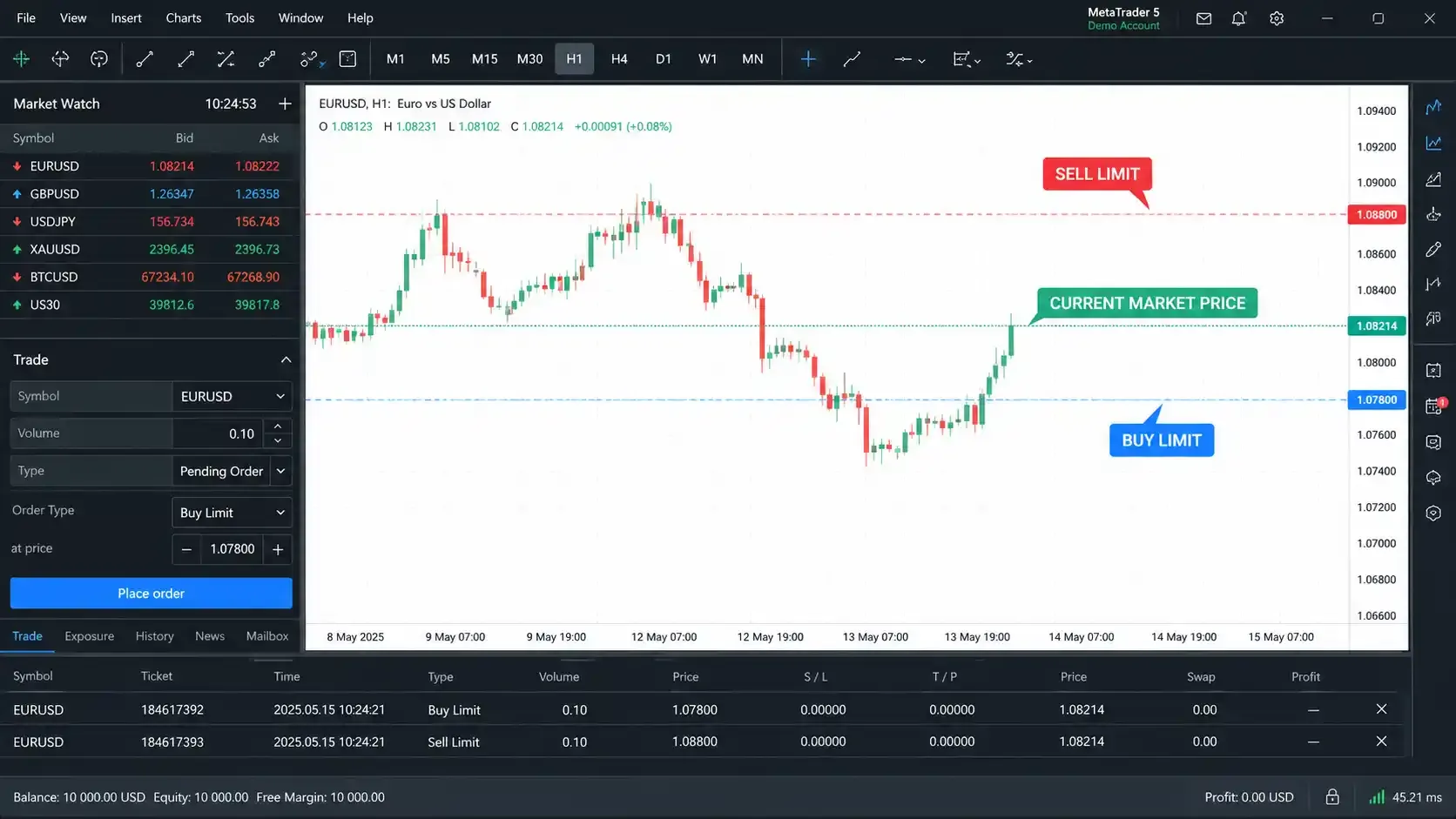
A buy limit is normally placed below the current price.
A sell limit is normally placed above the current price.
If EUR/USD is currently trading near 1.1000:
Buy limit example: 1.0950
Current price: 1.1000
Sell limit example: 1.1050
The buy-limit trader wants the market to become cheaper before buying.
The sell-limit trader wants the market to become more expensive before selling.
Both are waiting for the price to move toward a preferred entry level rather than taking the available market order price immediately.
How a Buy Limit Works
A buy limit is commonly used when a trader believes a market could decline temporarily before moving higher.
Suppose GBP/USD trades at:
1.2800
A trader sees a potential support area around:
1.2750
Instead of buying immediately at 1.2800, the trader places a buy limit at 1.2750.
Three broad outcomes are possible.
The market may decline to 1.2750, allowing the order to become eligible for execution.
It may turn higher before reaching 1.2750, leaving the trader without a position.
Or it may fall through 1.2750 and continue downward after the position opens.
A limit order improves control over entry price, but it does not tell the market to reverse after the order is filled.
That is why a better entry price does not automatically mean a better trade.
Buy Limit Example
Imagine EUR/USD is trading at:
1.1080
A trader believes the broader structure remains bullish but does not want to buy after the recent rise.
The trader identifies 1.1020 as a price where buying would be more attractive.
The planned order could look like:
Current price: 1.1080
Buy limit: 1.1020
Planned stop-loss: 1.0980
Possible target: 1.1100
The trader is willing to participate only if EUR/USD first falls by approximately 60 pips.
If the pair reaches 1.1020, the buy limit may execute.
If it rises directly to 1.1150, the trader misses that move.
This missed trade is part of using a limit order. The trader chose price discipline over immediate market participation.
How a Sell Limit Works
A sell limit works in the opposite direction.
It is normally placed above the current market because the trader wants to sell only if price first rises to a chosen level.
Suppose GBP/USD is currently:
1.2700
A trader believes resistance may develop around:
1.2760
The trader places a sell limit at 1.2760.
If GBP/USD rises to the required level and the order is filled, a short position may open.
If GBP/USD falls directly from 1.2700, the trader remains out of the trade.
Again, the trader gives up certainty of participation in exchange for greater control over the requested entry level.
Sell Limit Example
Assume gold is trading at:
2,480
A trader expects a resistance area around:
2,500
Instead of selling immediately, the trader places a sell limit around 2,500.
The plan might be:
Current gold price: 2,480
Sell limit: 2,500
Planned stop: 2,515
Intended target: 2,460
If gold rises to the entry level, the order may execute.
If the price falls directly from 2,480 to 2,450, the trader misses the move.
If the order executes at 2,500 and gold continues rising through 2,515, the position loses money.
A limit order controls the requested entry condition; it does not make the resistance level reliable.
Why Traders Use Limit Orders
One reason traders use limit orders is to avoid chasing price.
Suppose EUR/USD rises sharply from 1.0900 to 1.1000. A trader may still believe the broader trend is upward but decide that buying at 1.1000 creates an unattractive entry.
A buy limit at a lower level allows the trader to wait for a pullback.
Limit orders can also make trade planning more structured. Entry, stop-loss and potential target can be considered before the position exists.
For traders who cannot watch every price movement continuously, this can be practical.
Someone in Peshawar, Mardan, Abbottabad or Swat may be following a European or US market session while also managing work or other responsibilities. A properly planned pending order can remove the need to click manually at one exact moment, although the order still needs to be reviewed if market conditions change.
Limit Order vs Market Order
A market order and limit order solve different problems.
A market order says:
Enter now at the best available market price.
A limit order says:
Enter only if the market reaches my chosen price condition.
The market order prioritizes participation.
The limit order prioritizes price.
Suppose GBP/USD trades at 1.2800.
Trader A believes the opportunity is available now and buys using a market order.
Trader B believes 1.2750 would provide a better entry and places a buy limit.
If GBP/USD rises directly to 1.2900, Trader A participates while Trader B may receive no trade.
If GBP/USD falls to 1.2750 before recovering, Trader B may obtain the lower entry.
Neither method is automatically superior.
The correct choice depends on the trade idea and how much entry-price control matters.
Understanding bid price vs ask price is also important because market quotes contain separate buying and selling prices.
Limit Order vs Stop Order
Limit and stop orders are often confused.
The key difference is the type of price movement the trader wants before entering.
A limit order usually seeks a more favorable price.
A stop entry generally waits for price to move beyond a trigger in the direction of a potential breakout.
If EUR/USD trades at 1.1000:
Buy limit: normally below 1.1000
Buy stop: normally above 1.1000
For selling:
Sell limit: normally above 1.1000
Sell stop: normally below 1.1000
A trader expecting a pullback may prefer a limit order.
A trader waiting for a breakout may prefer a stop entry.
The order type should reflect the market idea rather than being selected simply because one order seems more sophisticated.
Does a Limit Order Guarantee Execution?
No.
A limit order can remain unfilled if the market never reaches the required price.
Even touching the displayed level does not always mean that every order at that price can be filled.
Execution depends on available liquidity and the way the instrument is priced and traded.
Consider a sell limit placed at 1.1050.
The chart briefly displays 1.1050, but available liquidity may be limited, or the relevant bid/ask side required for the order may not satisfy the execution condition in the way the trader expects.
Understanding the bid-ask spread helps explain why a chart appearing to touch a level does not always correspond exactly to the price relevant for every order.
Can a Limit Order Get a Better Price?
Depending on execution conditions, a limit order may sometimes receive an equivalent or more favorable fill than the specified limit.
The important principle is that a limit instruction places a boundary on the price conditions the trader is willing to accept.
However, traders should not build a strategy around expecting price improvement.
The main purpose is control over the acceptable entry price, not predicting how the execution system will improve it.
Limit Orders and the Bid-Ask Spread
The spread matters when placing limit orders because forex and many other instruments have separate bid and ask prices.
Suppose EUR/USD displays:
Bid: 1.1000
Ask: 1.1002
The trader looking only at a chart may mentally treat the market as being at "1.1000," but a buy order is affected by the ask side.
This difference becomes particularly important when limit levels are placed very close to the current market.
The spread markup and other pricing components can also affect the effective trading cost.
A limit order may improve the entry level, but the position still begins within the relevant bid-ask structure.
Limit Orders and Trading Costs
A lower entry price does not eliminate trading costs.
Depending on the account and instrument, a trade may still involve spread, commission or overnight financing.
The complete effect is easier to understand alongside trading costs explained.
Suppose two traders enter similar positions.
Trader A uses a market order.
Trader B receives a buy-limit fill five pips lower.
Trader B may have improved the entry by five pips, but the final result still depends on the spread, commission, exit price and any financing costs.
Entry quality is only one component of total trade performance.
Limit Orders and Slippage
Slippage is more commonly associated with market and stop orders, but execution details still matter when using limits.
Markets can change quickly, particularly around economic announcements.
A trader should understand how the platform handles pending orders, partial fills where relevant, price gaps and unavailable liquidity.
The difference between market execution and instant execution can also help explain why the displayed price and final fill need to be considered separately.
Execution is especially important for strategies that depend on small price differences.
Using Limit Orders Around Support and Resistance
Limit orders are frequently associated with support and resistance.
Suppose EUR/USD is trading above a level that previously acted as support.
A trader expects the market to revisit that area before moving higher.
Instead of waiting at the screen, the trader places a buy limit near the support zone.
The reasoning might be valid, but support does not guarantee a reversal.
Price can reach the level, activate the position and continue falling.
The same issue applies to a sell limit placed near resistance.
A resistance area indicates a place where selling pressure may appear. It does not force price to fall.
Limit Orders During Strong Trends
Strong trends create a common dilemma.
A trader may want a pullback before entering, but the market may continue moving without providing one.
Imagine gold rises steadily from 2,450 to 2,500.
A trader places a buy limit at 2,480.
Gold continues to 2,530 without returning to 2,480.
The trader receives no position.
It may feel frustrating to watch the market move in the expected direction without being involved, but changing the buy limit repeatedly just to chase the market defeats its original purpose.
A missed trade is not necessarily a trading mistake.
Limit Orders During Range-Bound Markets
Limit orders can also be used when a trader believes a market is moving between relatively stable boundaries.
Suppose EUR/USD repeatedly trades between:
Support: 1.0950
Resistance: 1.1050
A trader may consider a buy limit near the lower boundary or a sell limit near the upper boundary.
The risk is that ranges eventually break.
A buy limit near support can become a losing position if price breaks sharply below the range.
A sell limit near resistance can suffer if the market breaks higher.
Past reactions around a price level do not guarantee future reactions.
Setting a Stop-Loss With a Limit Order
A limit entry should usually be considered together with the amount of risk the trader intends to take.
Suppose a buy limit is placed at:
1.1000
A trader believes the setup is invalid below:
1.0950
The planned stop distance is:
1.1000 − 1.0950 = 0.0050
For EUR/USD, this is approximately 50 pips.
The next question is not simply whether 50 pips is a reasonable stop.
The trader also needs to decide how much money that 50-pip movement represents.
That depends on position size.
The principles of position sizing are therefore directly connected to limit-order planning.
Position Size Example
Suppose a trader is willing to risk $50 and the planned stop is 50 pips from the limit entry.
In simplified form:
Risk per pip = $50 ÷ 50
Risk per pip = $1
The trader would then need a position size that corresponds to approximately $1 per pip for the relevant pair and account currency, subject to the actual contract specification.
If the same trader accidentally selects a position worth $10 per pip, the planned loss becomes approximately:
50 pips × $10 = $500
The entry price has not changed.
The risk changed because the position size changed.
This is why understanding forex position size calculation can be more important than trying to improve an entry by a few pips.
Limit Orders and Leverage
Leverage allows larger market exposure to be controlled with a smaller margin requirement.
This does not make the limit order itself safer.
A trader may carefully wait for a perfect entry level and then undermine that discipline by taking excessive leverage.
The interaction between leverage and margin and position size determines how strongly a price move affects account equity.
A precise entry cannot compensate for uncontrolled exposure.
Limit Orders on MetaTrader 5
Medatiq users can manage supported pending-order functionality through MetaTrader 5.
When entering a limit order, the trader should verify the instrument, order direction, volume, requested price and any attached stop-loss or take-profit instructions.
This sounds simple, but trading order entry mistakes often happen because one field is overlooked.
A trader intending to use a buy limit can accidentally choose a different pending-order type.
A position size can also be entered incorrectly.
Checking the complete order ticket before submission reduces avoidable errors.
How to Read a Limit Order Ticket
A pending-order ticket may contain fields such as the trading symbol, order type, volume, price, stop-loss, take-profit and expiration.
Understanding how to read a trading order ticket helps prevent situations where the trader correctly identifies a market level but enters the wrong instruction.
Before confirming a limit order, check:
Instrument: Is this the intended market?
Direction: Buy limit or sell limit?
Volume: Is the position size correct?
Price: Is the limit on the correct side of the current market?
Risk controls: Are any stop and target instructions placed where intended?
Expiration: Should the order remain active indefinitely?
These details matter more than how quickly the order can be submitted.
Should a Limit Order Have an Expiration?
Not every trading idea remains valid forever.
Suppose a trader identifies a buy setup during the London session and places a buy limit.
The market never reaches the level during London hours.
Several hours later, new economic information changes the market outlook.
An old pending order may still be sitting on the platform unless it has been cancelled or given an expiration.
The difference between good-till-cancelled and day orders becomes important when a setup is valid only during a particular period.
A pending order should not remain active simply because the trader forgot about it.
Limit Orders Around Economic Announcements
Economic releases can move markets rapidly.
Suppose a trader places a EUR/USD buy limit shortly before a major US inflation report.
The market drops sharply after the release.
The buy limit may execute as EUR/USD falls through the selected level.
But the fact that the trader obtained the desired entry price does not mean the decline is finished.
Price may continue falling.
This is a particularly important consideration for traders in Pakistan because many major US economic announcements occur during afternoon or evening hours in PKT.
Someone in Peshawar, Abbottabad, Mardan or Kohat who places a pending order before leaving the screen should know when important data is scheduled rather than assuming the market will remain quiet.
Limit Orders and Connectivity
One practical benefit of a pending order is that it does not require the trader to click manually when price reaches the intended level.
That can be useful when following international markets from different parts of Khyber Pakhtunkhwa.
However, reliable connectivity still matters after a position opens.
A trader in Swat, Chitral, Bannu or another area where an internet connection may occasionally become unstable should think about how an open position will be managed if access is interrupted.
Predefined stop-loss and take-profit instructions can form part of that planning, though they do not eliminate execution risk.
The trader should never rely on being able to react manually at the last second.
Limit Orders in Forex Trading
Limit orders are widely used in forex trading because currency pairs often move back and forth around identifiable price areas.
A trader may use a buy limit when expecting EUR/USD to retrace before moving higher.
Another may use a sell limit when expecting GBP/USD to rise toward resistance before falling.
The forex market can also move rapidly around economic releases, which means a limit order should be evaluated together with spreads, volatility and position size.
Limit Orders in Gold Trading
Gold can produce large intraday movements, especially when interest-rate expectations, inflation data or geopolitical developments change.
A trader using Medatiq's commodities trading markets may place a buy limit below the current gold price during an upward trend or a sell limit above the market near an expected resistance area.
Gold's volatility means an attractive limit price can still be followed by a substantial adverse move.
Waiting for a lower entry does not remove the need for risk management.
Limit Orders in Indices
Limit orders can also be used on supported indices.
Suppose a US index falls rapidly after the market opens.
A trader may believe a lower price offers a better long entry and place a buy limit.
The risk is that the decline may reflect a meaningful change in market conditions rather than a temporary pullback.
US index activity often takes place during evening hours for traders in Pakistan, so pending orders may be convenient. They should still be reviewed around major economic releases and market openings.
Limit Orders in Cryptocurrency Markets
Cryptocurrency markets can be especially volatile.
A trader using supported cryptocurrency trading instruments might place a buy limit below the current Bitcoin price rather than entering after a sharp rise.
However, a rapidly falling crypto market can move through multiple expected support areas.
The limit price controls where the trader is willing to enter; it does not limit how far the market can move afterward.
Common Limit Order Mistakes
One common mistake is putting a buy limit above the current price or a sell limit below it when the trader actually intends to use another order type.
Another is choosing the correct entry but an excessive position size.
Some traders repeatedly move their limit order closer to the market because they are afraid of missing a trade. Eventually, what began as a disciplined pullback entry becomes an attempt to chase price.
Others leave old pending orders active long after the original market conditions have changed.
A further mistake is assuming that a limit order is low risk simply because the entry price is better than the current price.
The risk of the position depends on what happens after entry.
Limit Orders and Trading Latency
For most ordinary limit-order strategies, tiny differences in network latency are less important than position size and market conditions.
Even so, trading latency can matter in fast markets.
If the market changes rapidly, the trading system still needs to process price information and orders according to the available execution environment.
Short-term strategies that depend on extremely small price movements are more sensitive to these details than longer-term setups.
When a Limit Order Makes Sense
A limit order can make sense when a trader has identified a specific price at which the trade becomes more attractive.
It may also be suitable when the setup depends on a pullback rather than immediate continuation.
The trader should still ask several questions.
Why is this price preferable?
What happens if the market reaches the level with unusually strong momentum?
How far away is the stop?
How large will the position be?
Is an important economic announcement approaching?
How long should the pending order remain valid?
A limit order is most useful when those questions have been considered before it is placed.
When a Limit Order May Not Be Suitable
A limit order may not fit a setup where immediate participation is essential.
For example, if a trader's method requires entering only after a confirmed event has occurred and the market is already moving, waiting for a retracement could mean no position is opened.
Limit orders can also create poor outcomes when traders automatically buy every decline or sell every rise without considering why the price is moving.
A rapidly falling market is not necessarily becoming safer simply because it is cheaper.
Limit Order FAQs
What is a limit order in simple terms?
A limit order tells the trading platform to buy or sell only when specified price conditions are reached rather than entering immediately at the current market price.
What is a buy limit?
A buy limit is normally placed below the current market price. It is used when a trader wants to buy only after price falls to a chosen level.
What is a sell limit?
A sell limit is normally placed above the current market price. It is used when a trader wants to sell only after price rises to a chosen level.
What is the difference between a limit order and a market order?
A market order prioritizes immediate execution at the best available price. A limit order prioritizes obtaining a specified price condition but may remain unfilled.
Does a limit order guarantee my trade will open?
No. If the market never reaches the required level, the order may not execute.
Can the market touch my limit price without filling the order?
It can happen depending on the relevant bid/ask price, available liquidity and execution conditions. A chart displaying a level does not necessarily mean every pending order at that level was fillable.
Is a buy limit always below the current price?
Under the standard order structure, a buy limit is placed below the current market because it seeks a lower buying price.
Is a sell limit always above the current price?
Under the standard structure, a sell limit is placed above the current market because the trader seeks a higher selling price.
What happens after a buy limit executes?
Once executed, it becomes an open long position and its value will rise or fall with subsequent market movement, subject to costs and execution conditions.
What happens after a sell limit executes?
It becomes an open short position. The position benefits if the market subsequently falls and loses value if the market rises, before considering applicable costs.
Can I attach a stop-loss to a limit order?
Supported platforms commonly allow traders to define stop-loss and take-profit instructions alongside pending orders, subject to the platform and account conditions.
How long does a limit order stay active?
That depends on the chosen expiration condition. Some remain active until cancelled, while others can expire at a specified time.
Is a limit order safer than a market order?
Not inherently. A limit order provides more control over the requested entry price, but the position can still produce substantial losses after execution.
Can I use limit orders for forex in Pakistan?
Eligible traders can use supported order functions according to the platform and account conditions. The basic mechanics do not change because the trader is located in Pakistan.
Are limit orders different in KPK?
No. A buy or sell limit works the same whether a trader is in Peshawar, Mardan, Abbottabad, Swat or another KPK city. Local time, connectivity and the ability to monitor international sessions can affect how the order is managed.
Why might pending orders be useful for traders in Pakistan?
International market activity can occur at times when traders are busy or away from their screens. A planned pending order can wait for a specified price without requiring a manual click at that exact moment.
Can a limit order protect me from slippage?
Limit orders provide price constraints, but traders should still understand the platform's execution rules and the effect of unusual market conditions.
Should I move my limit order if the market starts moving away?
Moving an order should follow the trading plan, not fear of missing out. Continually chasing the current market can remove the price advantage that motivated the limit order in the first place.
Should every limit order have a stop-loss?
There is no universal rule for every market or strategy, but traders should decide before entry how an adverse move will be managed and how much financial exposure they are willing to accept.
What should I check before placing a limit order?
Confirm the instrument, buy or sell direction, requested price, position size, risk, any stop-loss or target, expiration conditions and upcoming market events.
Disclaimer: A limit order can control the price conditions under which a trade is entered, but it cannot guarantee that the order will be filled or that the resulting position will be profitable. Markets can continue moving against a position after a buy or sell limit executes, and leverage can magnify the resulting loss. This article provides general educational information rather than personalized investment, trading, financial, legal or tax advice. Medatiq's available markets, spreads, execution arrangements, margin requirements and account conditions may change.



Trade forex, gold, and indices with Medatiq Markets
Enjoy tight spreads and fast execution, built for market condition.