Market Orders Explained: How Immediate Execution Works
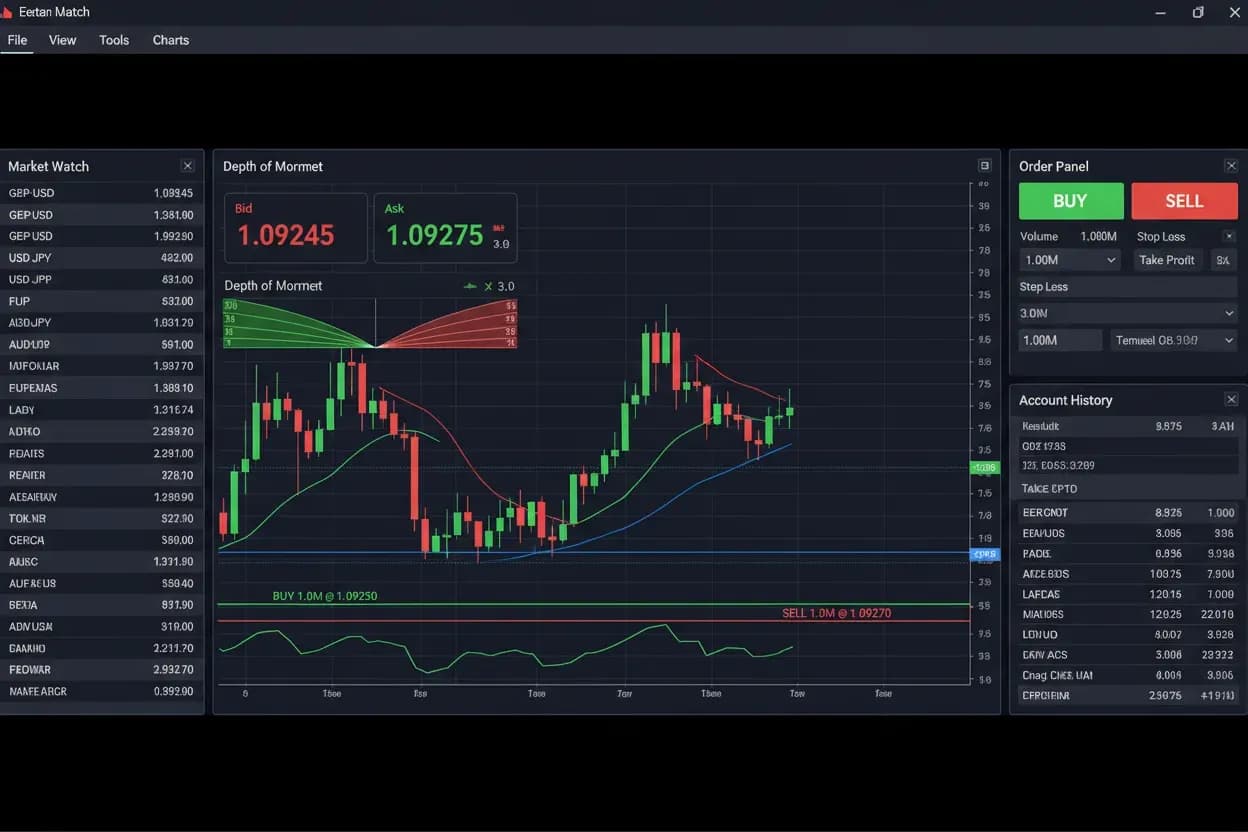
A market order is an instruction to buy or sell a financial instrument at the best available price when the order reaches the market.
It is commonly used when entering or exiting quickly matters more than obtaining one exact price. If EUR/USD is moving rapidly and a trader submits a market order, the position is generally filled using the available bid or ask price, but that price can change between the moment the order is sent and the moment it is executed. This is why the price visible on a chart is not always the exact price received. Spreads, liquidity, volatility, slippage and connection conditions can all influence execution. A market order provides speed and a high likelihood of participation under normal conditions, but it does not guarantee a specific price. Understanding that distinction is essential before using immediate-execution orders in forex, gold, indices, cryptocurrency or other leveraged markets.
A market order is one of the core trading order types available through modern trading platforms. It differs significantly from a limit order, where the trader waits for a specified price rather than entering immediately.
What Is a Market Order?
A market order tells the trading platform to execute a buy or sell instruction using the best available price under current market conditions.
Suppose EUR/USD displays:
Bid: 1.1000
Ask: 1.1002
If a trader submits a market buy order, the order generally seeks execution around the available ask price.
If the trader submits a market sell order, execution generally occurs around the available bid.
The exact fill can be different from the price shown when the trader clicked because financial markets continue moving while the order is being processed.
This is particularly important when volatility is high.
How a Market Order Works
A market order usually follows a simple sequence.
The trader selects an instrument, chooses buy or sell, specifies the position size and submits the instruction.
The platform sends the order for execution.
The order is then filled at an available price according to the applicable execution conditions.
The final price becomes the position's entry price.
Even though this process can occur very quickly, the market does not stop moving while it happens.
That small time difference explains why immediate execution does not mean guaranteed execution at the exact displayed price.
Market Buy Order
A market buy order is used when a trader wants to establish a long position immediately.
Suppose GBP/USD shows:
Bid: 1.2798
Ask: 1.2800
A trader believes the pair may continue rising and submits a market buy.
The order seeks execution around the available ask.
If the market remains stable, the fill could be close to 1.2800.
If GBP/USD moves rapidly upward while the order is being processed, the actual entry could be higher.
After execution, the trader gains when the market moves sufficiently above the entry price to overcome applicable trading costs and loses when price moves lower.
Market Sell Order
A market sell order is used when a trader wants to establish a short position immediately.
Using the same GBP/USD quote:
Bid: 1.2798
Ask: 1.2800
A market sell generally seeks execution around the bid price.
If GBP/USD subsequently falls, the short position moves favorably before considering costs.
If the pair rises, the position moves against the trader.
The difference between the two displayed prices is explained by the bid price vs ask price, which is fundamental to understanding how immediate orders enter the market.
Market Order Example
Suppose EUR/USD is trading around:
Bid: 1.1050
Ask: 1.1052
A trader sees an upward move and wants to enter without waiting for a pullback.
The trader submits a market buy.
The order is filled at:
1.1053
The trader saw 1.1052 when clicking, but the actual entry is one pip higher because the available price changed during execution.
If EUR/USD later reaches 1.1103, the gross movement from the actual entry is:
1.1103 − 1.1053 = 0.0050
That represents approximately 50 pips.
Calculating the monetary result still requires position size and any applicable costs.
Market Order vs Limit Order
The main difference between a market order and limit order is the trade-off between immediate participation and price control.
A market order says:
"Enter now at the best available price."
A limit order says:
"Enter only if my specified price conditions are available."
Suppose EUR/USD trades at 1.1050.
A trader using a market order enters around the current price.
Another trader may place a buy limit at 1.1000 and wait.
If EUR/USD immediately rises to 1.1150, the market-order trader participates in the move while the limit-order trader may receive no position.
If EUR/USD first falls to 1.1000, the limit-order trader may obtain a better entry.
Neither approach is universally better. They suit different trading plans.
When Traders Use Market Orders
Market orders are often used when immediate execution matters more than waiting for a more favorable price.
A trader may use one after a setup has already been confirmed and delaying entry would contradict the trading method.
They can also be used to close an existing position quickly.
For example, a trader may decide that the reason for holding EUR/USD is no longer valid and submit a market order to exit rather than wait for a particular target.
Market orders are also common in actively traded markets where available liquidity is normally sufficient for ordinary retail position sizes.
However, even liquid markets can behave differently during volatile periods.
What Does "Best Available Price" Mean?
Best available price does not mean the best price that will appear later.
It refers to the available market price when the order is being executed.
A trader cannot use a market order to demand a particular future price.
Suppose EUR/USD asks are available around:
1.1000
1.1001
1.1002
The exact execution depends on available liquidity, position size and how prices change during processing.
If the trader needs a strict upper or lower price condition, another order type may be more appropriate.
Market Orders and the Bid-Ask Spread
A market order interacts directly with the bid and ask prices.
A buyer generally enters through the ask.
A seller generally enters through the bid.
The difference is the bid-ask spread.
Suppose EUR/USD displays:
Bid: 1.1000
Ask: 1.1003
The spread is three pips.
If a trader buys at approximately 1.1003 and immediately closes without any market movement, the sale would generally occur around the bid side.
The spread therefore affects the position from the beginning.
This is why traders should look at both sides of the quote rather than only the chart line.
What Is Slippage on a Market Order?
Slippage occurs when the actual execution price differs from the price a trader expected when submitting the order.
Suppose a trader sees EUR/USD at:
Ask: 1.1000
The trader submits a market buy.
The actual fill occurs at:
1.1004
The difference is four pips.
That is unfavorable slippage.
A better-than-expected price can also occur in some circumstances, producing favorable slippage.
The important point is that the requested action is immediate execution, not execution at one guaranteed number.
Why Slippage Happens
Financial prices can change extremely quickly.
Between clicking and execution, available liquidity may shift or another participant may trade at the displayed price.
Slippage becomes more likely when volatility increases or market depth is limited.
Major economic announcements are a common example.
US employment figures, inflation data or central-bank decisions can cause EUR/USD, GBP/USD and other markets to move several price levels almost immediately.
A market order submitted during such a period may receive a noticeably different fill from the price visible just before the click.
Liquidity and Market Orders
Liquidity describes how readily buying and selling interest is available without causing a large change in price.
Highly liquid markets tend to support smoother execution for normal transaction sizes.
Low-liquidity conditions can produce wider spreads and larger price changes between available levels.
Liquidity is not constant.
EUR/USD may trade actively during the London–New York overlap but behave differently during quieter periods.
Gold, indices and cryptocurrency instruments also experience changing liquidity throughout their active periods.
This is one reason the same market order can behave differently at different times.
Market Orders During Volatile Conditions
Volatility measures the size and speed of price movement.
When volatility rises, market orders can receive fills further away from the price initially seen.
Imagine gold trading around:
2,500
A major announcement occurs, and prices begin moving quickly between:
2,500
2,504
2,508
2,503
A market buy submitted during this movement may not fill at 2,500 simply because that price appeared on the screen immediately before submission.
The available price may already have changed.
This does not automatically mean that the platform malfunctioned. It can reflect rapidly changing market conditions.
Market Orders During Economic News
Market orders require additional care around scheduled economic events.
Inflation data, employment reports, interest-rate decisions and central-bank speeches can create sharp movements in currencies, gold and indices.
For traders in Pakistan, many important European releases occur during the daytime, while major US announcements often arrive later in Pakistan Standard Time.
A trader in Peshawar, Mardan, Abbottabad, Swabi or Nowshera may therefore encounter some of the most active forex and US-market periods in the afternoon or evening.
Before submitting an immediate order around a major announcement, it helps to understand that spreads and execution conditions can change quickly.
Market Orders and Trading Sessions
The time of day can influence execution quality because trading activity changes as major financial centers open and close.
EUR/USD and GBP/USD often attract considerable participation during European trading hours and the London–New York overlap.
Asian currency pairs may experience greater activity during Asian sessions.
For someone in Khyber Pakhtunkhwa, the local clock is different from London, New York or Tokyo, but the underlying market is the same.
A trader in Peshawar and another trader in London can both submit a market order on EUR/USD. Their location differs, while the exchange-rate market being traded is global.
Market Orders and Trading Costs
Immediate execution does not remove trading costs.
The spread can affect the position as soon as it is opened.
Depending on the account and instrument, commissions or financing may also apply.
Understanding trading costs is particularly important for strategies that use many market orders.
Suppose a strategy makes 30 trades rather than three.
Even a relatively small cost per transaction can accumulate significantly over repeated entries and exits.
The quality of the market prediction is therefore only part of the final result.
Market Orders and Commission
Some pricing structures separate the spread from a commission charged according to trading volume.
A trader should therefore understand commission per lot before comparing trading costs.
A tight displayed spread does not automatically mean the total transaction cost is low.
Similarly, a wider spread does not tell the entire story without knowing whether another commission is charged.
A market order should be evaluated using the full cost structure.
Position Size Matters More Than Entry Speed
Submitting the correct order type is important, but position size can have a much greater effect on financial risk.
Suppose two traders buy EUR/USD using market orders at approximately the same price.
Trader A uses a small position.
Trader B uses a position ten times larger.
If the market falls 50 pips, Trader B experiences roughly ten times the monetary effect, assuming equivalent contract specifications.
Understanding position sizing is therefore essential before worrying about whether execution differed by one or two pips.
A small amount of slippage on a properly sized position may be manageable. Excessive position size can make an ordinary market movement damaging.
Market Orders and Fixed-Dollar Risk
Some traders decide how much money they are willing to lose before determining position size.
This approach is closely related to fixed-dollar risk trading.
Suppose the maximum planned loss on a trade is $50.
If the intended stop distance is 25 pips:
Planned risk per pip = $50 ÷ 25
Planned risk per pip = $2
The appropriate position size would need to correspond with that risk level for the actual instrument and account currency.
The market order determines how the trader enters.
Position sizing determines the scale of the financial exposure.
Market Orders and Stop-Losses
A trader can place a market order and then use a stop-loss to define an intended exit if the market moves against the position.
Suppose EUR/USD is bought at:
1.1000
The trader places a stop at:
1.0950
The intended stop distance is approximately 50 pips.
However, the stop price should not be treated as an absolute guarantee of the maximum possible loss.
If the market gaps through the level, execution may occur at another available price.
This is why trading risk management must consider more than one order setting.
Closing a Position With a Market Order
Market orders are used not only to open positions but also to close them.
Suppose a trader is long EUR/USD and decides to exit immediately.
Submitting the appropriate closing instruction seeks to close the position at the available market price.
This can be useful when the original market reasoning has changed or when the trader simply wants to remove exposure.
Again, the exact closing price may differ from the price visible immediately before submission.
The final profit or loss should be calculated from the actual entry and exit fills rather than the prices the trader expected to receive.
Market Execution vs Instant Execution
The terms "market order" and "market execution" are related but are not always interchangeable descriptions of every platform process.
Execution models determine how an instruction is processed when market prices change.
Understanding market execution vs instant execution can help explain what happens between order submission and the final fill.
For ordinary traders, the practical question is straightforward:
If the displayed price changes before the order is completed, how will the platform handle the instruction?
Knowing this before entering a volatile market can prevent incorrect assumptions about execution.
Market Orders on MetaTrader 5
Medatiq provides supported trading functionality through MetaTrader 5.
When submitting a market order, the trader typically selects the instrument, volume and direction before confirming the transaction.
The order ticket should be checked carefully.
Selecting the correct symbol matters.
Selecting the correct direction matters.
Position volume matters even more because an incorrect decimal or lot size can create substantially greater exposure than intended.
The details of how to read a trading order ticket are worth understanding before using one-click or rapid-entry features.
One-Click Trading and Market Orders
One-click trading can make market entry very fast.
This can be convenient for traders who need immediate execution, but speed removes some of the opportunity to review the order before it is submitted.
A trader may accidentally select the wrong volume or direction.
For beginners, taking a few seconds to verify the trade can be more valuable than entering marginally faster.
Fast execution is useful only when the order itself is correct.
Common Market Order Entry Mistakes
Several execution mistakes have little to do with predicting the market.
A trader may select EUR/USD instead of GBP/USD.
Another may enter 1.0 lot instead of 0.1 lot.
Someone intending to sell may click buy.
A stop-loss may be entered on the wrong side of the market.
These issues are covered more closely in trading order entry mistakes, but the simplest prevention is a consistent pre-trade check.
Before submitting a market order, confirm the instrument, direction, volume and intended risk.
Market Orders and Trading Latency
Trading latency refers broadly to delays involved in transmitting price information and trading instructions between systems.
For many ordinary trading approaches, extremely small latency differences are less important than market volatility, position size and risk management.
However, latency can matter more in strategies that depend on very small and rapid price changes.
Connection reliability also matters in practical terms.
For someone trading from Abbottabad, Chitral, Swat, Kohat or another part of KPK, an unstable connection can make active trade management difficult during fast markets.
A trader should therefore avoid building a risk plan that assumes uninterrupted manual access at every moment.
Market Orders in Forex Trading
Market orders are frequently used in forex trading because currency prices move continuously during active sessions.
A trader may submit a market order after an economic release, technical breakout or other setup.
The main advantage is immediate participation.
The disadvantage is less control over the exact entry price.
Forex traders should pay particular attention to spreads and volatility because both can change quickly around economic news.
Market Orders in Gold and Commodities
Gold and other supported commodities can experience rapid changes when inflation expectations, interest rates, energy supply or geopolitical conditions shift.
A market order can provide fast participation, but a fast-moving gold market can also produce noticeable slippage.
Someone who sees gold at 2,500 should not assume a market order is guaranteed to execute at exactly 2,500.
Available prices may already have changed.
Market Orders in Indices
Supported indices can move sharply around major market openings and economic announcements.
US index activity is particularly relevant during evening hours in Pakistan.
A trader in Peshawar or Mardan submitting an immediate order near a US market open may encounter more volatility than during a quieter period.
That does not necessarily make the market unsuitable, but the execution environment should be understood before taking exposure.
Market Orders in Cryptocurrency Markets
Supported cryptocurrency trading instruments can experience rapid price movements.
A market order prioritizes getting into or out of the position quickly, but that speed can come with greater uncertainty about the precise fill during highly volatile conditions.
This is particularly important when position size is large relative to the account.
The more volatile the underlying instrument, the more important it becomes to understand the financial effect of even a modest difference between expected and actual execution.
Market Orders and Raw Spreads
Some account structures may use pricing associated with a raw spread, often alongside a separate commission.
For market-order traders, the important consideration is the total transaction cost.
A very narrow quoted spread may look attractive, but commission must also be included when evaluating the entry and exit.
Trading costs should therefore be considered as a complete structure rather than as one isolated number.
Should Beginners Use Market Orders?
Market orders are straightforward to understand, but straightforward does not mean risk-free.
They can be useful for beginners because the basic instruction is clear: buy or sell now.
However, new traders should understand spreads, position sizing and potential slippage before using them with real financial exposure.
Practicing order entry can also help reduce simple platform mistakes.
The technical act of clicking buy or sell is easy.
Determining whether the position size and risk are sensible requires much more attention.
When a Market Order Makes Sense
A market order can make sense when a trading plan requires participation immediately after a condition is met.
It may also be appropriate when closing a position quickly is more important than waiting for a particular exit price.
The key is that immediate execution should be intentional.
A trader should not use a market order simply because the price is moving quickly and they are afraid of missing out.
Urgency created by the trading setup and urgency created by emotion are not the same thing.
When a Market Order May Be Less Suitable
A market order may be less suitable when the trader will participate only at a specific price.
If EUR/USD is trading at 1.1050 but the trade is attractive only near 1.1000, entering immediately contradicts that plan.
A limit order may better reflect the intended entry condition.
Market orders can also be less attractive during periods of extreme volatility when execution-price uncertainty becomes unusually high.
Sometimes choosing not to trade is more appropriate than accepting execution conditions the trader does not understand.
A Practical Market Order Example
Suppose GBP/USD trades at:
Bid: 1.2800
Ask: 1.2802
A trader sees confirmation of a setup and decides to buy immediately.
The market order fills at:
1.2803
The trader plans a stop around:
1.2753
The approximate stop distance is:
50 pips
The trader intends to risk $100.
The required risk per pip would therefore be approximately:
$100 ÷ 50 = $2 per pip
The position size should be selected accordingly, using the actual contract specifications.
Notice that the one-pip difference between the expected and actual entry is relevant, but the larger financial decision is still the size of the position.
Checking a Market Order Before Submission
Before submitting the order, confirm that the correct instrument is selected.
Check whether the instruction is buy or sell.
Verify the position volume.
Look at both the bid and ask.
Consider the spread.
Know where the position will be exited if the original idea fails.
Check whether an important economic announcement is approaching.
These few checks can prevent many avoidable mistakes.
Medatiq users who need assistance with platform or account access can use Medatiq support, while information about the company is available on the Medatiq Markets page.
Market Order FAQs
What is a market order in simple terms?
A market order is an instruction to buy or sell immediately using the best available market price under the current execution conditions.
Does a market order guarantee execution?
Under normal market conditions it is designed to prioritize execution, but the exact outcome depends on available liquidity and the applicable execution process.
Does a market order guarantee the price I see?
No. The market may move between submission and execution, so the final fill can differ from the displayed price.
What price does a market buy use?
A market buy generally interacts with the available ask side of the quote.
What price does a market sell use?
A market sell generally interacts with the available bid side.
What is the difference between a market order and limit order?
A market order seeks immediate execution, while a limit order waits for specified price conditions and may never execute.
What is slippage?
Slippage is the difference between the price expected when an order is submitted and the actual execution price.
Is slippage always negative?
No. Execution can sometimes occur at a more favorable price, although unfavorable slippage is the outcome traders usually worry about.
Why is my market-order price different from the chart?
Charts may display a particular side of the market or update while the order is being processed. The bid-ask spread and changing available prices can also create differences.
Are market orders faster than limit orders?
A market order seeks immediate participation, while a limit order waits for a specified price. They serve different purposes rather than simply being faster and slower versions of the same instruction.
Can I use a market order to close a trade?
Yes. Market orders are commonly used to close existing positions when immediate exit is preferred.
Can market orders be used for forex?
Yes. They are commonly used for supported forex instruments when the trader wants to enter or exit at the available market price.
Can market orders be used for gold?
Yes, subject to the available instrument and account conditions. Gold can be volatile, so execution-price differences deserve particular attention.
Can market orders be used for indices?
Yes, for supported index instruments. Volatility around market openings and economic announcements can influence execution.
Can I place a market order from Pakistan?
Eligible traders can submit supported orders through the available platform according to their account conditions. The mechanics of the order are the same as elsewhere.
Do market orders work differently in KPK?
No. A market order works on the same underlying instrument whether the trader is in Peshawar, Abbottabad, Mardan, Kohat or another KPK city. Local connectivity and the timing of international sessions can affect the practical trading experience.
Does internet speed affect market orders?
Connection quality can affect how quickly instructions reach the trading infrastructure, although market volatility and liquidity can also influence the final fill.
Should I use a market order during major economic news?
That depends on the trading plan and acceptable risk. Prices, spreads and execution conditions can change extremely quickly during major announcements.
Is a market order good for beginners?
It is one of the simplest order types to understand, but beginners still need to understand spread, slippage, position sizing and leverage before using it with real money.
Can a market order cause a bigger loss than expected?
Yes. Excessive position size, leverage, rapid market movement or unexpected execution can all cause larger losses than a trader initially anticipated.
Disclaimer: Market orders prioritize immediate participation but do not guarantee a particular execution price, especially when prices are moving quickly or liquidity is changing. Leveraged positions can magnify the financial effect of small market movements and may result in substantial losses. This article is educational and does not provide individualized trading, investment, financial, legal or tax advice. Instruments, spreads, commissions, margin requirements, execution arrangements and other Medatiq account conditions may be revised or vary by market.



Trade forex, gold, and indices with Medatiq Markets
Enjoy tight spreads and fast execution, built for market condition.