Day Trading: Strategies, Setups & Risk Management

Day trading focuses on capturing intraday price movements without carrying positions into a later session. Learn how setups, timing, execution, position sizing, and disciplined risk controls shape the process.
Day trading is a short-term trading approach in which positions are normally opened and closed within the same trading session rather than intentionally carried overnight. A day trader tries to capture intraday price movement using defined setups based on trend, momentum, breakouts, pullbacks, reversals, volume, support and resistance, or other measurable market behavior. The objective is not simply to trade frequently. Effective day trading requires a repeatable decision process in which the entry, invalidation point, position size, target, transaction costs, and conditions for standing aside are understood before capital is committed.
That distinction matters because intraday markets constantly produce movement without constantly producing high-quality opportunities. A trader who reacts to every candle can accumulate spreads, commissions, slippage, and impulsive losses faster than meaningful gains. A structured approach treats day trading as one branch of broader market strategies, with each trade evaluated according to a defined setup rather than excitement or the desire to remain active. Medatiq's broader trading education and market insights also provide context for the technical concepts that interact with short-term decision-making.
What Is Day Trading?
Day trading involves establishing and closing a market position during the same trading day or defined trading session. A trader may hold a position for several minutes, an hour, or much of a session, but the strategy normally avoids deliberately keeping the trade open overnight. This makes day trading different from swing trading, where positions may remain open across several sessions while the trader waits for a broader price swing to develop.
It also differs from scalping trading. Scalpers typically pursue much smaller price movements and may complete numerous trades within a period in which a day trader takes only one or two. A day trader may accept a wider stop and wait for a larger intraday move, whereas a scalper generally works with a shorter decision horizon and greater sensitivity to execution costs.
Consider a market that opens with strong upward momentum, pulls back toward an established intraday support area, and then begins moving higher again. A day trader might enter after the pullback confirms, place a stop below the structure that invalidates the setup, and hold toward a later resistance level. A scalper observing the same market could enter and exit several times during smaller movements inside that broader intraday trend.
The holding period changes, but the central requirement remains the same: the trader needs a repeatable reason to enter and a predefined reason to exit.
How Day Trading Works
A complete day trade usually develops through four stages: market preparation, setup identification, trade execution, and post-trade review. Preparation gives the trader a framework for deciding what conditions matter. Setup identification determines whether the market currently satisfies those conditions. Execution converts the plan into an actual position, while review measures whether the process worked as intended regardless of whether a particular trade made or lost money.
The first decision is often directional context. Is price trending upward, trending downward, rotating inside a range, compressing before a possible breakout, or behaving erratically? This classification affects which setups make sense. A trend-following entry can work poorly inside an unstable range, while a mean-reversion entry may be especially vulnerable when a strong directional move has just begun.
Once context is established, the trader needs an observable trigger. That could be a breakout above resistance, a pullback into support, rejection from a level, confirmation after a trendline break, or increased participation as price leaves a consolidation. The trader then defines where the setup fails. Without an invalidation level, there is no objective basis for determining how much capital is actually at risk.
Day trading therefore depends less on predicting every market movement and more on responding consistently when predetermined conditions appear.
Day Trading Timeframes
The timeframe used for analysis changes the amount of market noise, the number of potential setups, the size of typical price swings, and the speed at which decisions must be made. Many traders combine multiple charts rather than relying on a single timeframe.
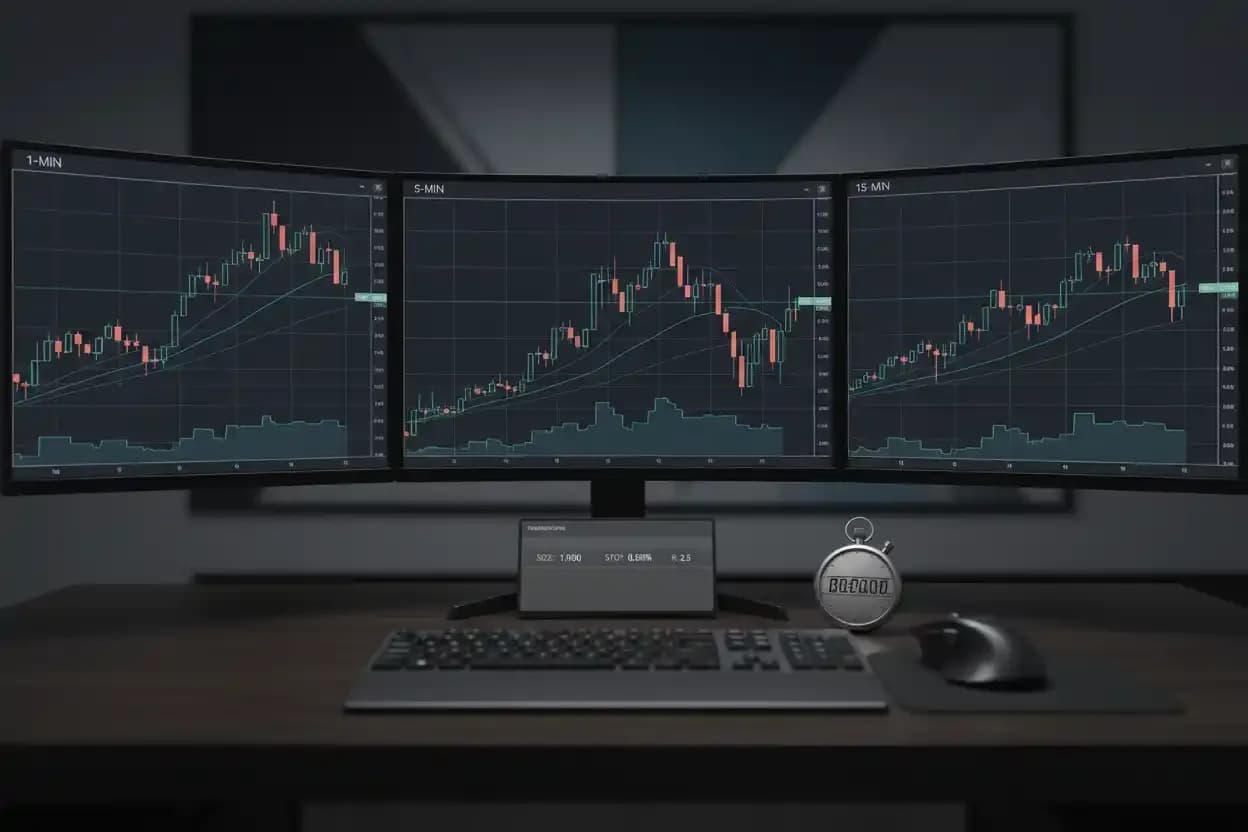
A higher intraday chart may establish structure while a faster chart refines the entry. For example, a trader might use a one-hour chart to identify the broader directional environment, a 15-minute chart to locate important intraday levels, and a five-minute chart to trigger the trade. Another trader may rely primarily on five-minute and 15-minute charts because the method does not require extremely precise short-term entries.
The appropriate combination depends on the setup rather than a universal rule. The dedicated guide to day trading timeframes examines these differences more closely, but the central principle is straightforward: the execution chart should be fast enough to capture the intended opportunity without becoming so fast that random price fluctuations dominate the trader's decisions.
Lower timeframes generate more apparent signals. They also generate more false starts and demand faster responses. Higher intraday timeframes usually produce fewer setups but provide more context around each movement. A trader should therefore choose timeframes based on the strategy being tested rather than changing charts repeatedly until a desirable signal appears.
Core Day Trading Strategies
Day trading is not one specific trading system. It is a holding-period framework that can contain several different strategies. The logic behind a breakout trade is different from the logic behind a pullback or trend-continuation trade, so each setup needs its own rules.
Trend-Following Day Trading
Trend-based day trading attempts to participate in an established intraday directional move rather than repeatedly betting against it. If the market forms higher highs and higher lows, a trader may wait for a pullback into support and enter when upward momentum resumes. During a downtrend, the same concept can be reversed.
The approach shares principles with broader trend trading, but the trade is managed within an intraday horizon. The trader may close at the next resistance level, at a predetermined reward multiple, or when the intraday trend structure breaks rather than holding for a multi-session move.
Trend direction alone is not an entry signal. Buying simply because the market has risen can mean entering after the move is already extended. A more disciplined process waits for a location and trigger that allow the stop to be placed at a logical structural point.
Breakout Day Trading
Breakout setups occur when price moves outside an established boundary such as resistance, support, a consolidation range, the high or low of a defined period, or another clearly observed structure. A breakout day trading strategy seeks to participate when that movement creates sufficient follow-through to justify an intraday position.
This setup belongs to the broader family of breakout trading, where one of the main challenges is distinguishing genuine expansion from a false break. Price can move beyond a level, attract entries, and then reverse sharply back into the previous range. Waiting for confirmation can reduce some false entries, although additional confirmation also means entering at a less favorable price.
Volume can add another dimension. A trader studying a volume breakout strategy may compare current participation with recent activity to determine whether a break is occurring with stronger market involvement. Volume still needs context; unusually high activity can accompany both continuation and exhaustion.
Trendline Break Setups
Trendlines can help visualize the direction and slope of a short-term movement. When price repeatedly respects a line and then breaks through it, the change may signal weakening momentum, consolidation, or a transition into a different structure.
A trendline break strategy should not treat every line crossing as an automatic entry. The quality of the structure, number of meaningful touches, surrounding support and resistance, and price behavior after the break all influence whether the signal deserves attention.
For day traders, trendline breaks can serve either as entry signals or as warnings to stop pursuing the previous trend. That second function is sometimes more valuable because avoiding a low-quality continuation trade preserves capital for clearer opportunities.
Market-Specific Intraday Setups
Some trading approaches require adjustments for the market being traded. A setup that behaves one way in a highly liquid currency pair may respond differently in another instrument because volatility, trading hours, liquidity, spreads, and reaction speed differ.
For example, a trader researching a crypto day trading strategy must account for the structural characteristics of those markets rather than assuming rules developed for conventional session-based instruments transfer directly. The same principle applies across asset classes: strategy rules should reflect the behavior of the instrument being analyzed.
For traders focused on currencies, Medatiq's forex trading information provides the commercial service context separately from the educational strategy framework discussed here.
The Importance of a Defined Trade Setup
A setup is a repeatable set of market conditions that must exist before a trade becomes eligible. Without those conditions, day trading can quickly become discretionary in the worst sense: the trader sees movement, feels compelled to participate, and invents the justification after entering.
A well-defined setup might specify the broader trend, the level at which price must arrive, the confirmation required for entry, the location of the stop, the method for establishing the target, and circumstances that invalidate the trade before entry.
Suppose a hypothetical trader follows a pullback setup. The rules could require an established intraday uptrend, a retracement toward a previously broken resistance level, a rejection candle showing renewed buying pressure, and a stop below the pullback low. The trader does nothing if any required element is absent.
That discipline reduces the number of trades, but the objective is not to maximize trade frequency. It is to maximize consistency between the strategy being tested and the trades actually being executed.
Position Sizing for Day Trading
Position sizing connects the technical setup to account risk. A trader should determine the maximum acceptable loss first and then calculate the position size from the distance between entry and stop.
A simple starting calculation is:
Cash risk = Account equity × Risk percentage
Consider a hypothetical account containing PKR 500,000. If the trader chooses a maximum risk of 0.5% on one trade:
PKR 500,000 × 0.005 = PKR 2,500
The maximum planned loss would therefore be PKR 2,500 before allowing for execution differences and trading costs.
The position size then depends on the stop distance. A trade requiring a wider stop needs a smaller position to keep cash risk at PKR 2,500. A trade with a narrower structurally valid stop may support a larger position. The critical phrase is structurally valid. Tightening the stop simply to increase position size can place the exit inside normal market noise and make the risk calculation meaningless.
This process keeps risk anchored to the account rather than to emotion. After several winning trades, the trader does not automatically increase size because confidence is high. Following several losses, the trader does not increase exposure simply to recover quickly.
Risk-to-Reward Ratios and Expectancy
Risk-to-reward describes the amount a trader is prepared to lose relative to the intended gain. If a trade risks PKR 2,500 and targets PKR 5,000 before costs, the planned reward-to-risk ratio is 2:1, or 2R of potential reward for 1R of risk.
A 2:1 target does not make a trade profitable by itself. The probability of reaching the target matters. A strategy that wins only 20% of the time can still lose money with a 2R target, while a strategy with a lower reward multiple can potentially remain viable if its win rate is sufficiently high and transaction costs remain controlled.
Expectancy combines these variables:
Expectancy = (Win rate × Average win) − (Loss rate × Average loss) − Average trading costs
Assume a hypothetical strategy wins 45% of the time, the average winner equals 1.8R, and the average loser equals 1R. Before costs:
(0.45 × 1.8R) − (0.55 × 1R) = 0.26R
The theoretical expectancy is +0.26R per trade before spread, commission, slippage, and execution errors.
This is why a trader should not judge a day trading method solely by win rate. A 70% win rate can still lose money if occasional losses are several times larger than the average winner. Conversely, a method can lose more trades than it wins and remain positive if profitable trades are sufficiently larger.
A dedicated approach to day trading profit targets can help formalize exits rather than allowing greed or fear to determine when a winning position is closed.
Stop-Loss Placement Should Follow Market Structure
A stop defines the point at which the reasoning behind a trade is considered invalid. It should therefore relate to the setup rather than being chosen arbitrarily.
If a trader buys after price rebounds from support, a stop could be positioned beyond the structure whose failure would contradict the bullish setup. If the market then moves decisively below that area, the original trade thesis has weakened or failed.
Using an extremely tight stop can reduce nominal risk per unit but may cause normal price fluctuations to close the position repeatedly. Using an excessively wide stop can create a poor relationship between risk and the expected intraday opportunity. Position sizing should adjust to the valid stop distance instead of moving the stop to accommodate an oversized position.
Stops also do not guarantee an exact exit price during fast market movement. Slippage can occur, particularly when liquidity changes or volatility rises sharply. A realistic risk plan therefore recognizes that actual losses can differ from the theoretical calculation.
Transaction Costs Can Change a Day Trading Strategy
Every trade creates friction. Depending on the instrument and account structure, that friction can include spread, commission, slippage, financing or other applicable charges. Day traders frequently open more positions than longer-term traders, so small costs can accumulate into a substantial part of total performance.
Suppose a trader completes 10 trades during a session. If the combined average cost is hypothetically PKR 300 per trade, total trading friction for the day reaches:
10 × PKR 300 = PKR 3,000
If the strategy generates only PKR 4,000 of gross profit before costs, the net result falls to PKR 1,000. A small deterioration in execution could remove the remaining edge completely.
This is particularly important when profit targets are small. A strategy should be tested using realistic bid-and-ask prices and reasonable assumptions about execution rather than assuming every order receives the exact chart price.
Traders using the MetaTrader 5 platform should understand available order types, chart functionality, displayed pricing, position information, and execution controls before attempting fast intraday decision-making.
Pre-Market Preparation
Professional day trading starts before the first entry. A trader who begins by reacting to whichever chart is moving most aggressively is already allowing the market to dictate attention rather than following a prepared process.
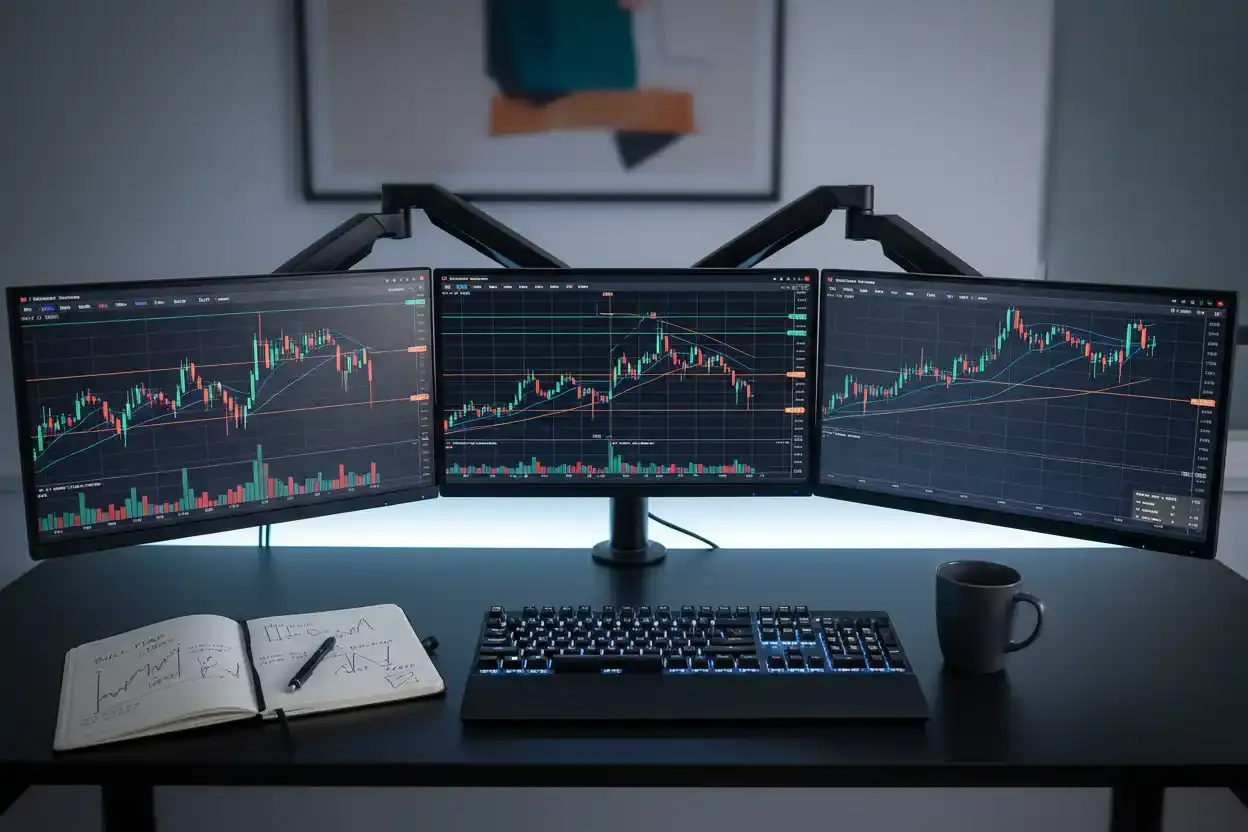
A structured day trading pre market routine can establish which instruments are being monitored, where important levels are located, what market conditions are present, which setups are permitted, and what conditions would justify remaining completely inactive.
Preparation might include marking the previous session's high and low, identifying important support and resistance, assessing whether the market is trending or ranging, reviewing current volatility, and determining the maximum allowable loss for the session.
The value of this routine is not that it predicts the day. Its value is that it reduces the number of decisions that must be invented under pressure.
Day Trading in Pakistan Standard Time
For traders based in Pakistan, one practical challenge is aligning an intraday routine with the active hours of the markets they follow. Pakistan Standard Time remains the local reference, while several major international financial centers change their clocks seasonally. Consequently, the relationship between PKT and some overseas trading sessions does not remain identical throughout the year.
A day trader should therefore confirm current market and platform times rather than relying permanently on a memorized conversion. Broker server time can also differ from Pakistan Standard Time, which affects candle timestamps, session markers, trade records, and journal entries.
This is especially relevant when a strategy has been tested during a particular period of liquidity. A setup observed during an active international session may behave differently during quieter hours. Traders in Peshawar, Abbottabad, Mardan, Swat, or elsewhere in Khyber Pakhtunkhwa face the same analytical requirement as traders elsewhere in Pakistan: match the trading routine to the actual market conditions being studied rather than assuming every hour offers equivalent liquidity and volatility.
The Role of a Day Trading Journal
Memory is unreliable when assessing dozens or hundreds of trading decisions. Traders naturally remember unusual wins, frustrating losses, and near misses more clearly than routine executions. A structured day trading journal converts those impressions into measurable records.
A useful journal can record the instrument, entry time, market condition, setup type, entry price, planned stop, target, position size, estimated transaction costs, actual exit, result in R, and whether every strategy rule was followed. Screenshots before and after the trade can add valuable structural context.
The journal should also separate process quality from financial outcome. A profitable trade taken outside the trading plan is still a process error. A losing trade that followed every rule may be a perfectly valid execution because no legitimate strategy wins every time.
Over a sufficiently large sample, patterns become clearer. The trader may discover that one setup performs poorly during low-volatility periods, that most rule violations occur after consecutive losses, or that certain targets are consistently unrealistic.
Overtrading: One of the Main Intraday Risks
Day trading provides constant access to price movement, which can create the false impression that opportunities are always available. After a losing trade, the desire to recover immediately can turn a disciplined trader into a highly active one. After a large winning trade, overconfidence can produce the same effect.
Day trading overtrading usually occurs when trade frequency becomes disconnected from the actual strategy. Entries begin to appear because the trader is bored, frustrated, excited, or unwilling to end the session rather than because predefined conditions are present.
One practical control is a maximum number of trades or a defined daily loss limit. Another is requiring a complete setup checklist before every entry. These constraints do not guarantee better performance, but they can prevent emotion from transforming one poor decision into a sequence of increasingly undisciplined trades.
The broader catalogue of day trading mistakes includes similar process failures such as chasing extended moves, moving stops farther away, increasing position size impulsively, trading without a plan, and confusing activity with productivity.
Why Daily Loss Limits Matter
A trader can follow a sound strategy and still experience several losses in succession. That is normal statistical variation. The problem develops when emotional deterioration after those losses changes how subsequent trades are handled.
Suppose a trader risks 0.5% of account equity on each trade and establishes a maximum daily loss of 1.5%. After three full-risk losing trades, the session ends. The trader does not attempt a fourth position solely to recover the first three.
A daily loss limit places a boundary around a bad session. Without one, position size may increase, entry standards may decline, and the loss that should have remained manageable can expand considerably.
The same reasoning applies to fatigue. Decision quality can deteriorate even when the trader is not losing. If attention drops after several hours of monitoring charts, continuing to trade simply because the market is still open can undermine an otherwise disciplined process.
Market Conditions Matter More Than the Number of Setups
A day trading strategy should identify the environment in which it is intended to operate. Trend-following setups generally need directional structure. Breakout strategies need meaningful boundaries and sufficient movement beyond them. Range strategies need price to continue respecting recognizable extremes.
Problems arise when traders use the same setup regardless of market condition. A breakout trader may repeatedly buy above resistance during a choppy session in which every break quickly fails. A trend trader may continue entering pullbacks even after the original trend has deteriorated into a range.
The market does not owe a trader a setup each day. Some sessions may provide several valid opportunities while others provide none. The ability to remain inactive is therefore part of risk management rather than a failure to participate.
Trading Platforms and Execution
Day traders depend on reliable familiarity with their execution environment because intraday positions can require relatively fast decisions. Before trading actively, the trader should understand how to enter and modify orders, place stops and targets, read bid and ask prices, review open positions, monitor margin information, and close trades correctly.
Platform knowledge is not a substitute for strategy. It simply reduces avoidable operational errors. A strong trading idea can still produce a poor result if the wrong order size is entered, a stop is placed incorrectly, or a position remains open unintentionally.
Medatiq presents its broader trading services separately from strategy education, while information about Medatiq Markets provides additional brand context for readers evaluating the company and its services.
Day Trading Performance Should Be Measured in Samples
One profitable week does not prove that a strategy has a durable edge, just as one losing week does not automatically invalidate it. Short samples are highly sensitive to randomness.
Suppose a strategy has been tested over only 10 trades and wins seven. The observed win rate is 70%, but the sample is far too small to assume that 70% represents long-term performance. An additional series of losses could change the measured result dramatically.
A more useful review separates setup performance from execution performance. The trader asks whether the strategy itself produced positive expectancy across a meaningful sample and whether actual trades followed the strategy correctly. Poor results can come from a weak method, poor execution, excessive transaction costs, or a combination of all three.
Recording each trade in R multiples also makes comparison easier. If a trader risks PKR 2,500 on one setup and PKR 1,000 on another, comparing only rupee gains and losses can obscure the quality of the decisions. Expressing both trades relative to initial risk allows performance to be studied on a normalized basis.
When Day Trading Becomes Gambling-Like Behavior
The difference between structured trading and uncontrolled speculation is not determined simply by whether a position lasts five minutes or five days. The more meaningful distinction lies in the decision process.
A trader using a defined setup, predetermined risk, documented execution rules, and performance records can evaluate whether the method has behaved as expected. A trader entering positions randomly, doubling size after losses, following rumors without a plan, or relying on hope instead of an invalidation level has no equivalent framework.
Fast markets make this distinction particularly important because immediate feedback can encourage repeated action. The emotional cycle of winning, losing, recovering, and trying again can quickly replace analytical decision-making.
A trading plan therefore needs rules for both action and inactivity. Knowing when not to trade is part of the strategy.
Choosing Between Day Trading, Scalping and Swing Trading
The appropriate holding period depends on the strategy, available monitoring time, tolerance for rapid decisions, and ability to follow risk controls consistently.
Scalping typically requires the highest decision frequency and the greatest sensitivity to execution costs. Day trading allows somewhat larger intraday movements to develop but still requires active monitoring and same-session risk management. Swing trading operates on a longer horizon and may require less continuous screen time, although overnight and multi-session exposure introduces different risks.
None of these styles automatically produces better results. A trader who performs well with patient, structured decisions may struggle when forced into rapid entries. Another trader may prefer the immediate feedback of intraday setups and find multi-day positions difficult to manage psychologically.
The useful comparison is therefore operational: which approach allows the trader to define, test, execute, and review a repeatable process without violating risk limits?
A Practical Day Trading Framework
A robust day trading process can be summarized without turning trading into an oversized checklist. Before entry, the trader should be able to answer four questions clearly:
- What specific market condition makes this setup valid?
- Where does the trade become objectively wrong?
- How much account equity is at risk if that level is reached?
- What condition or price determines the exit if the trade moves favorably?
If any answer is unclear, the trade is not fully defined.
After the trade closes, the review should ask whether execution matched the plan rather than focusing only on profit or loss. Repeating this cycle across a meaningful sample creates information that can actually be analyzed.
Conclusion
Day trading is a structured intraday approach, not simply the practice of buying and selling frequently. Sustainable execution requires clearly defined setups, appropriate timeframes, realistic transaction-cost assumptions, disciplined position sizing, planned exits, and a process for reviewing performance.
Trend continuation, breakouts, trendline breaks, volume confirmation, and other setups can all operate within day trading, but none removes the need for risk control. The strongest process defines what must happen before entry, exactly where the setup fails, how much capital is exposed, and when the trader should stop participating for the day.
Disclaimer: Day trading setups can fail quickly, and leverage can magnify intraday losses. This content is educational and does not constitute personalized financial or trading advice.
Trade forex, gold, and indices with Medatiq Markets
Enjoy tight spreads and fast execution, built for market condition.