Scalping Trading: Strategies, Timeframes & Risks
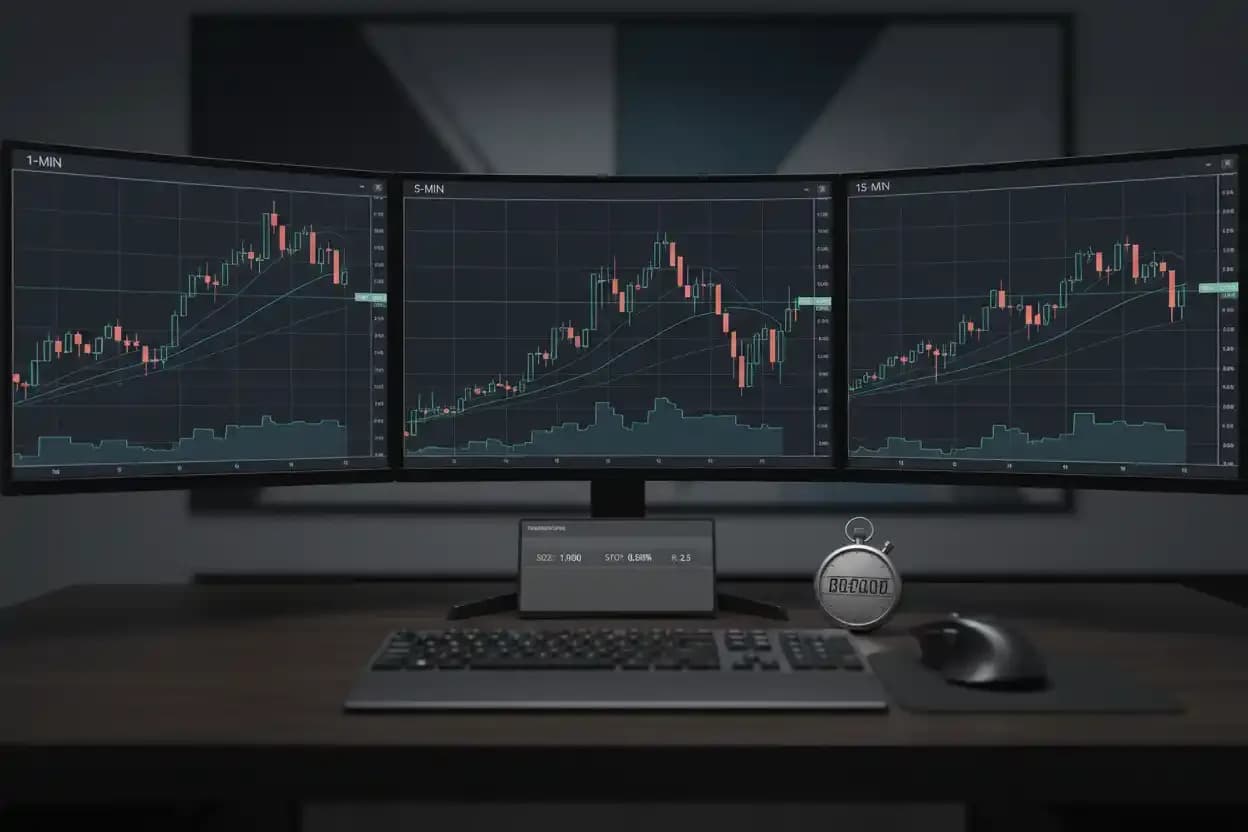
Scalping trading focuses on capturing small, frequent market movements over seconds or minutes. This guide explains the main strategies, timeframes, execution demands, costs, and risk controls involved.
Scalping trading is a short-term trading approach that attempts to capture relatively small price movements through trades that may last from a few seconds to several minutes. Instead of waiting for a large directional move, a scalper looks for repeated opportunities where price movement, liquidity, momentum, volatility, or temporary market imbalance creates a measurable setup. The individual gain targeted on each trade is usually modest, which means execution quality, transaction costs, position sizing, and consistency matter much more than they might in a slower strategy. A method that appears profitable before costs can become unprofitable once spreads, commissions, slippage, and losing trades are included.
The defining feature of scalping trading is therefore not simply that trades are “fast.” It is that the entire decision process is compressed. Entry, invalidation, exit, cost, and risk must usually be defined before the trade is opened because there may be little time to reconsider once price starts moving. Traders who want a wider view of how short-term methods fit into other market approaches can compare scalping with broader strategies, while the Medatiq trading education and market insights section covers related concepts that affect execution and market analysis.
What Is Scalping Trading?
Scalping trading is built around the idea that a trader does not need a large market move to create a trading opportunity. Instead, the trader attempts to participate in a small segment of price movement and then exit before the original setup has time to develop into a much larger trade. A scalper might enter during a brief breakout, a momentum burst, a pullback to a moving average, a return toward a short-term mean, or a reaction around a clearly defined price level. The exact setup can vary considerably, but the holding period usually remains short and the expected price movement is relatively limited.
This structure separates scalping from day trading, even though both approaches normally focus on short-term market movement. A day trader may hold a position for a substantial portion of a trading session while waiting for a larger intraday move to develop. A scalper may complete several separate trades during the same period because the target is not the entire session trend. The trader is repeatedly evaluating whether a small, immediate edge exists.
Frequency alone does not make an approach effective. Ten poorly selected trades are not automatically better than one carefully structured trade. In scalping trading, frequency magnifies both good and bad process. If a method has positive expectancy after trading costs, additional valid opportunities may help express that edge over a larger sample. If the method has negative expectancy, trading more frequently can simply cause the losses and costs to accumulate faster.
How Scalping Trading Works
A scalping decision normally combines three elements: a defined market condition, an entry trigger, and a precise invalidation point. The market condition establishes when the trader should even consider participating. For example, price may be trending strongly, consolidating near an important level, returning toward a short-term average, or expanding after a period of compressed volatility. The entry trigger then identifies the specific event that justifies opening the position, while the invalidation level identifies the point at which the original reasoning is no longer valid.
Suppose a currency pair has been making a sequence of higher intraday highs and higher lows. Rather than buying randomly because the market appears bullish, a scalper might wait for price to retrace toward a short-term support area, stabilize, and then resume upward momentum. The potential trade would have a defined entry, a stop placed beyond the structure that invalidates the setup, and a target based on the next nearby price level or a predetermined risk-to-reward relationship. Traders focusing specifically on currencies may apply the same principles through a dedicated forex scalping strategy, while information about Medatiq's broader forex trading offering is available separately.
Scalping can also use range-based logic. A trader may identify a market repeatedly oscillating around a short-term equilibrium and attempt to participate when price stretches away from that area and begins returning. This resembles the logic behind mean reversion trading, although a scalper normally works with a much shorter holding period and smaller expected price movement.
Common Scalping Timeframes
The one-minute and five-minute charts are among the most commonly discussed scalping timeframes because they provide detailed visibility into short-term price movement without requiring every decision to be based on individual ticks. They are not interchangeable, however. A one-minute chart produces more bars, more apparent setups, and more market noise. The trader has less time to interpret information, and transaction costs can represent a larger percentage of the expected move. A five-minute chart filters some of that noise and gives trades more room to develop, but it also produces fewer entry opportunities.
A 1 minute scalping strategy therefore needs tighter execution discipline than simply taking a conventional setup and viewing it on a faster chart. Spread changes, slight delays, and small bursts of volatility can have a meaningful impact when the target is only a few price increments away. A 5 minute scalping strategy may provide a little more structural context because each candle represents a longer period of trading activity, but the trader still has to control position size and execution carefully.
Many scalpers also use more than one timeframe. A higher intraday chart may establish whether the market is trending, ranging, or approaching an important level, while a faster chart is used to time the actual entry. For example, a trader could identify an upward structure on a 15-minute chart and then look for a one-minute or five-minute pullback that aligns with that broader direction. This prevents the lowest timeframe from becoming the only source of context.
Major Scalping Trading Strategies
Scalping trading does not depend on one universal setup. Different methods try to exploit different kinds of short-term market behavior, and each behaves differently depending on liquidity, volatility, spreads, and market structure.
Trend-Based Scalping
Trend scalping attempts to trade in the direction of an established short-term move. If price continues forming higher highs and higher lows, a trader may look for controlled pullbacks rather than chasing the market after a sharp upward candle. In a downtrend, the same logic can be reversed. This approach shares some principles with broader trend trading, but the profit objective and holding period are compressed substantially.
A trader using this approach may also rely on a structured trend trading strategy to establish directional context before moving to a faster entry chart. The key distinction is that a scalper may exit after a relatively small continuation move instead of remaining in the position for the full trend.
Moving-Average Scalping
Moving averages can help a trader judge short-term direction, dynamic support or resistance, and momentum changes. An EMA scalping strategy, for example, may use one or more exponential moving averages to determine whether price is maintaining directional momentum or returning toward a potential entry zone.
The moving average itself does not predict what price will do next. It is a calculation based on previous prices. Its value comes from providing consistent structure for a decision process. A trader might require price to remain above a short-term EMA, wait for a pullback toward it, and only enter when price begins moving upward again. The stop still needs to be tied to market structure rather than assuming the EMA will always hold.
Breakout Scalping
Breakout scalping focuses on short bursts of movement when price moves through a clearly observed boundary. A trader might watch a tight consolidation, session high, session low, or another repeatedly tested level. Once price breaks the boundary with sufficient momentum, the trader attempts to capture the initial expansion rather than holding for a prolonged trend.
A dedicated breakout scalping strategy can help distinguish genuine setup criteria from simply buying every upward break or selling every downward break. Broader breakout trading concepts are also relevant because false breakouts, liquidity conditions, and confirmation rules affect short-term entries. Pattern-based traders may encounter similar logic in a triangle breakout strategy, where a narrowing price structure creates a defined boundary before expansion.
Bollinger Band Scalping
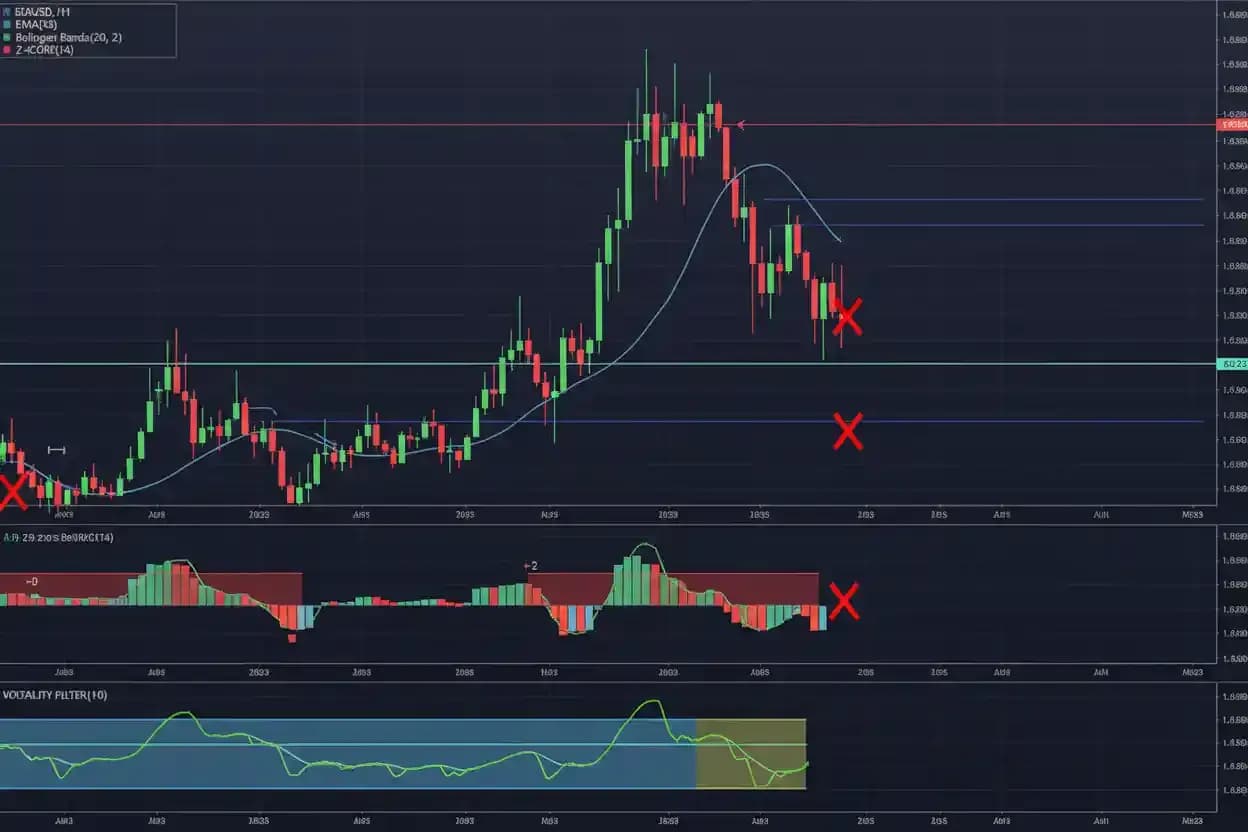
Bollinger Bands provide a visual representation of price relative to a moving average and a volatility-based envelope. A Bollinger Band scalping strategy might look for price expansion, contraction, trend continuation, or short-term reversion depending on the market environment.
Touching an outer band is not automatically a reversal signal. During strong directional moves, price can remain near an outer band for multiple candles. A scalper therefore needs additional context such as market structure, momentum, trend direction, or rejection behavior rather than assuming every band touch creates a valid countertrend opportunity.
The Mathematics of Trading Costs
Trading costs deserve unusual attention in scalping because each target is relatively small. Consider a hypothetical trade where the trader expects to capture 5 pips but the effective spread is 1 pip. Before accounting for commissions or slippage, 20% of the gross target is already represented by the spread. If another strategy seeks a 100-pip move with the same 1-pip spread, the proportional effect of that spread is much smaller.
A useful simplified calculation is:
Net result = Gross trading result − spread cost − commission − slippage
Assume a hypothetical scalper completes 20 trades, with an average gross outcome of +$4 per trade before costs. Gross profit would be $80. If the combined average transaction and execution cost is $2.50 per trade, total costs would reach $50, leaving only $30 before considering any other expenses. If the gross edge weakens slightly, the entire method can move from positive to negative expectancy.
Slippage creates an additional issue because the requested price and executed price may differ when the market moves quickly or liquidity changes. Scalpers should therefore evaluate strategies using realistic execution assumptions rather than chart entries that assume every trade occurs at the perfect visible price. The platform used for order entry also matters operationally; traders using the MetaTrader 5 platform, for example, should understand the order types, chart settings, execution information, and position-management tools available to them before attempting a rapid trading method.
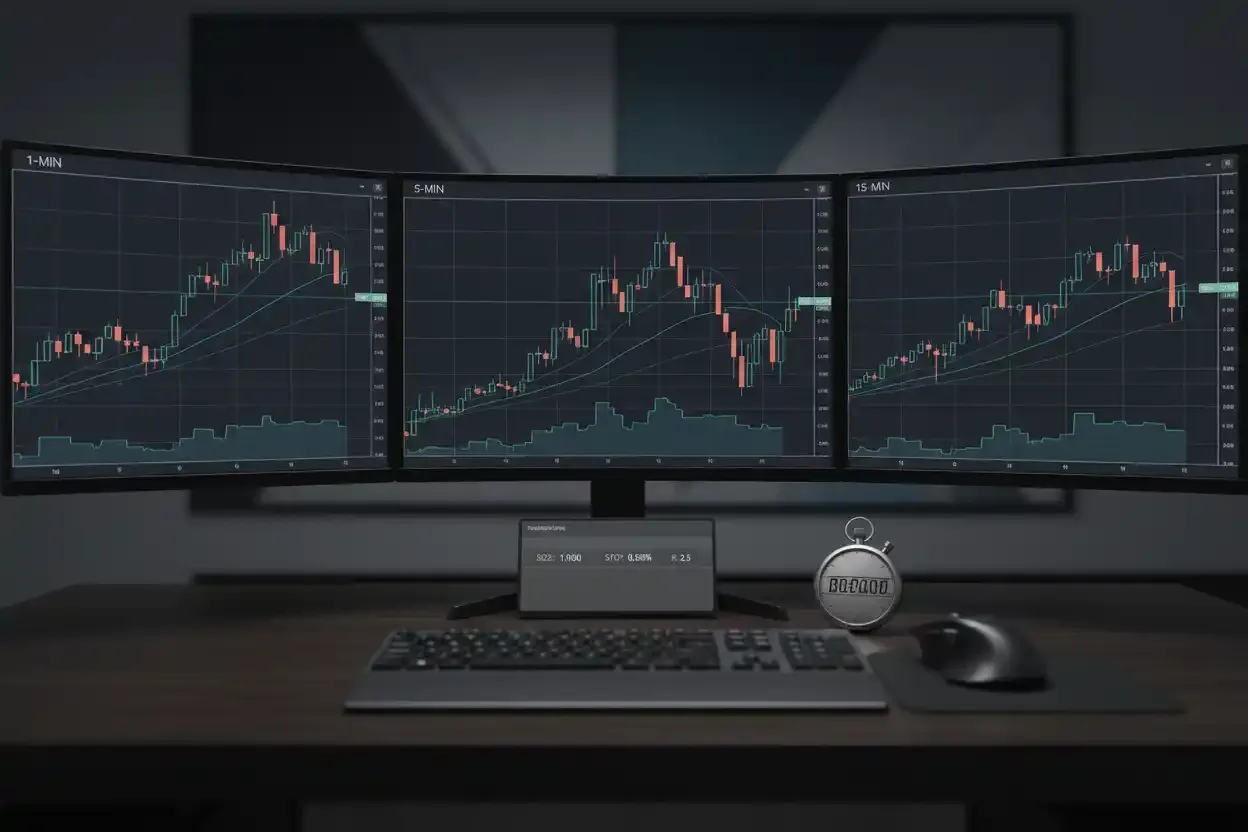
Scalping Trading Expectancy Matters More Than Win Rate
A high win rate can look attractive, but it does not tell a trader whether a scalping method is actually profitable. The relationship between average winning trade, average losing trade, transaction costs, and frequency matters more.
A basic expectancy formula is:
Expectancy = (Win rate × Average win) − (Loss rate × Average loss) − Average trading cost
Imagine a scalping strategy wins 55% of its trades. The average winner earns 0.7R, while the average loser loses 1R, where R represents the amount initially risked. Before costs:
(0.55 × 0.7R) − (0.45 × 1R) = −0.065R
Despite winning more often than it loses, the strategy has negative expectancy because the average loss is too large relative to the average win. Trading costs would make the result worse. By contrast, a strategy with a lower win rate can remain viable if the average winner is large enough relative to the average loss and costs remain controlled.
This is one reason scalpers should avoid judging a method from a handful of successful trades. A realistic sample needs to include losing streaks, quiet markets, volatile periods, spread changes, failed breakouts, and imperfect entries.
Risk Management in Scalping Trading
Risk management begins before the entry. A trader should know how much capital is being risked if the stop is reached and should size the position from that amount rather than choosing a position first and adjusting the stop afterward.
A simplified calculation is:
Cash risk = Account equity × Risk percentage
If hypothetical account equity is $10,000 and the trader chooses to risk 0.5% on one setup, cash risk is:
$10,000 × 0.005 = $50
Position size can then be calculated from the $50 risk allowance and the distance between entry and stop. If market structure requires a wider stop, the position size should become smaller. If the stop is tighter, the theoretical position size may increase, although the trader still has to consider spread, slippage, minimum trade size, and whether the stop is so tight that normal market noise can trigger it.
Short holding periods do not make risk disappear. In fact, rapid decision-making can create additional behavioral pressure because several losses may occur within a short period. One of the most damaging patterns is increasing position size after a losing trade in an attempt to recover immediately. Other recurring scalping mistakes include overtrading, entering without a defined invalidation level, ignoring trading costs, changing rules during a trade, and continuing to trade when attention has deteriorated.
Liquidity, Spread and Volatility
Scalping normally works best operationally when the instrument has enough liquidity for entries and exits to occur efficiently and when the spread is small relative to the intended target. A wide spread creates an immediate disadvantage because price must move farther in the trader's favor before the position reaches breakeven.
Volatility presents a more complicated trade-off. Too little volatility can make the potential move too small to justify the cost of trading. Excessive volatility can produce fast movement but also greater slippage, wider spreads, rapid reversals, and difficulty placing orders at expected prices. The desirable environment is not simply “high volatility”; it is sufficient movement combined with enough liquidity and structure for the trading method being used.
This relationship becomes particularly important when traders move between instruments. A strategy designed for a highly liquid currency pair may behave differently in gold because volatility, price increments, spreads, and reaction speed can differ. Traders focused on that market need to treat a gold scalping strategy as a distinct execution problem rather than assuming that currency-market settings transfer directly.
Scalping in Pakistan Standard Time
For traders in Pakistan, the main practical issue is translating international market activity into Pakistan Standard Time and understanding that the most active periods can shift relative to PKT during the year. Pakistan does not move its clocks in line with daylight-saving changes used in several major financial centers, so a trader should confirm the current relationship between local time, broker server time, and the market session being monitored rather than memorizing one permanent conversion.
That matters for scalping because liquidity and volatility can change sharply as major sessions open, overlap, and close. A setup tested during an active session should not automatically be expected to behave the same way during a quieter period. Traders in Khyber Pakhtunkhwa or elsewhere in Pakistan should therefore build their trading records around the actual session and server timestamps associated with each trade. The geographic location itself does not improve or weaken a strategy; what matters is whether the trader can consistently monitor the market during the conditions for which the method was designed.
Execution Discipline and Order Management
Scalping leaves little room for vague decision-making. A trader who enters without knowing the intended stop, target, and invalidation condition may find that the market moves too quickly to make a calm decision afterward. Predefining these elements also makes performance easier to measure because each trade can be compared against the same rules.
Limit orders, market orders, stop orders, and other execution methods can produce different outcomes depending on market conditions. A limit order may improve price control but can remain unfilled. A market order prioritizes execution but may experience slippage. The correct choice depends on the setup and the execution environment rather than a universal rule.
A useful trading journal should therefore record more than whether the trade won or lost. Entry time, session, instrument, setup type, planned risk, actual risk, spread, slippage, exit reason, and any deviation from the trading plan can reveal patterns that a simple profit-and-loss record will miss.
Why More Trades Do Not Automatically Mean More Opportunity
One of the psychological traps in scalping trading is equating market activity with opportunity. A chart can move continuously while offering very few high-quality setups. When a trader feels compelled to remain active, marginal entries begin replacing planned entries. That increases transaction costs and can weaken the statistical characteristics of the strategy.
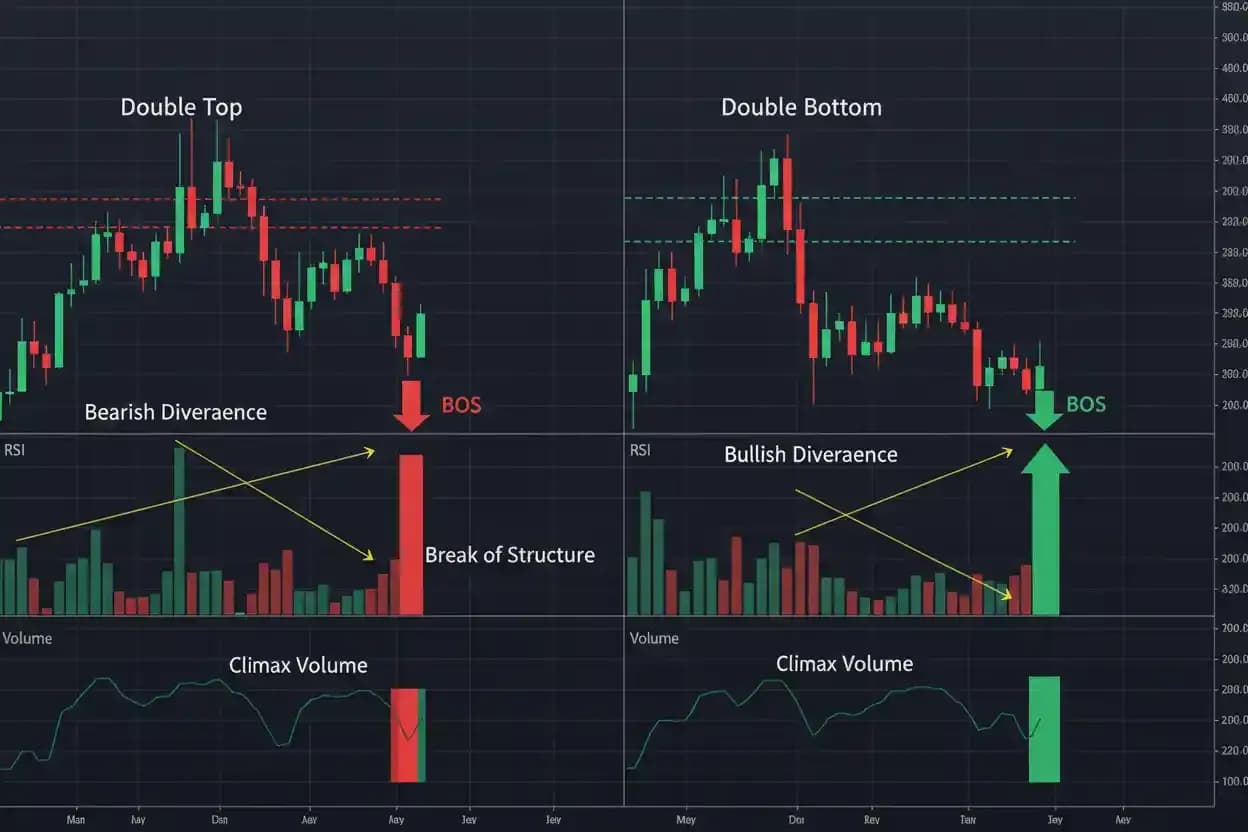
A practical approach is to define conditions under which no trade should be taken. A trend scalper may stand aside during an erratic range. A breakout trader may avoid entries when the market repeatedly crosses the same level without follow-through. A mean-reversion trader may stop fading moves when momentum becomes strongly directional. Each rule eliminates trades, but removing weak trades can be more important than increasing frequency.
This distinction also separates structured scalping from impulsive clicking. The goal is not to place as many trades as possible. The goal is to repeatedly execute a defined setup only when the market conditions that support it are present.
Scalping Versus Trend, Breakout and Mean-Reversion Trading
Scalping describes the holding period and trade-management style more than a single market philosophy. A scalper can use trend-following logic, breakout logic, mean-reversion logic, or combinations of these approaches. What changes is the timeframe, target size, and speed of execution.
For example, a trend trader may identify a multi-hour move and hold through several pullbacks, while a trend scalper may use the same directional bias but enter and exit only one small continuation leg. A breakout trader may hold after price escapes a major range, while a breakout scalper may capture only the first momentum burst. A mean-reversion trader may wait for a larger statistical deviation, whereas a scalper might target a small return toward a short-term equilibrium.
Understanding that distinction prevents traders from treating “scalping” as a complete strategy by itself. A complete method still needs rules that explain when to trade, what creates the entry, where the setup is invalidated, how profits are taken, what costs are acceptable, and when trading should stop.
Building a Structured Scalping Process
A workable scalping process should be specific enough that another person could identify whether the rules were followed from the trading record. Statements such as “buy when price looks strong” or “exit when momentum weakens” are difficult to test because they depend heavily on interpretation. Stronger rules define observable conditions.
A trader might require a higher-timeframe directional bias, a pullback into a predetermined zone, confirmation on the execution chart, a stop beyond a specific swing point, and a target equal to a fixed multiple of risk. Another method might wait for a narrow consolidation followed by a breakout and close the position if price returns inside the range. The exact rules can differ, but the process should be measurable.
Before increasing frequency or position size, the trader should examine whether the strategy remains viable after costs across a meaningful number of trades. Paper testing, historical review, and appropriately controlled live observation can each reveal different weaknesses. A method that appears attractive on historical candles can perform very differently when real execution delay, spreads, hesitation, and slippage are involved.
Medatiq provides information about broader trading services separately from these educational strategy discussions, allowing traders to review platform and service information independently from a particular trading method.
When Scalping Trading Becomes Difficult
Scalping becomes particularly difficult when the market lacks clear structure, spreads widen relative to the expected target, price changes faster than orders can be managed comfortably, or the trader's concentration begins to decline. It can also become difficult when a strategy requires so many conditions that opportunities are almost nonexistent, or so few conditions that nearly every market movement appears tradable.
Technology does not eliminate these problems. Faster charts and advanced platforms can display more information, but the trader still has to decide which information matters. Adding multiple indicators may create the appearance of precision while actually producing conflicting signals. A simpler method with clearly defined conditions is often easier to evaluate objectively than a screen filled with tools that have no documented role in the decision process.
The same applies to highly specialized setups. A method using moving averages should explain exactly how those averages affect entry and exit decisions. A breakout system should define what qualifies as a breakout. A Bollinger Band approach should specify whether it is attempting continuation or reversion. Without that precision, the label describes an idea rather than a repeatable strategy.
Is Scalping Trading Suitable for Every Trader?
Scalping demands sustained attention, rapid execution, tolerance for frequent small losses, and the discipline to stop when conditions are poor. Some traders prefer that intensity because decisions are resolved quickly and positions are not usually held for long periods. Others may find that the speed encourages impulsive trading or makes it difficult to follow a consistent process.
The appropriate question is therefore not whether scalping is universally better or worse than another method. The more useful question is whether the trader can define an edge, execute it consistently, absorb realistic trading costs, manage risk across a large sample, and maintain decision quality at the required pace.
A trader who repeatedly abandons rules under time pressure may be better served by a slower timeframe even if a scalping system looks attractive on historical charts. Conversely, a trader who works well with highly structured short-term decisions may find that the compressed feedback of scalping makes it easier to measure execution errors. What matters is the fit between the trading method, market conditions, risk limits, and the trader's ability to follow the process consistently.
Conclusion
Scalping trading is a demanding short-term approach built around capturing small price movements repeatedly rather than waiting for large market swings. Its viability depends on much more than finding fast entry signals. Spread, commission, slippage, liquidity, position sizing, expectancy, market structure, and execution discipline can determine whether an apparently successful setup produces a positive result after costs.
The strongest scalping process defines the market condition, entry trigger, invalidation level, target, allowable cost, and risk before the trade begins. Whether the trader uses trend continuation, moving averages, breakouts, Bollinger Bands, or another setup, the method should be measurable enough to test and consistent enough to evaluate over a meaningful sample of trades.
Disclaimer: Scalping setups can fail, and leverage can magnify losses quickly during short-term market moves. This material is educational and is not personalized financial or trading advice.

Trade forex, gold, and indices with Medatiq Markets
Enjoy tight spreads and fast execution, built for market condition.